
Prochyliza xanthostoma
Walker, 1849
Waltzing Fly, Cheese Skipper
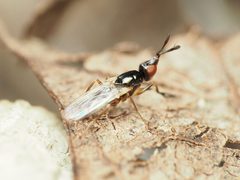
Prochyliza xanthostoma, commonly known as the waltzing fly or cheese skipper, is a of piophilid fly distributed throughout North America. The species exhibits extreme , with males possessing elongated , , and forelegs compared to females. It has become a prominent model organism for studies of , condition-dependent trait expression, and larval . are associated with animal carcasses, particularly in spring, where they mate and females oviposit. Larvae feed on carrion and can also infest cured meats and cheeses, earning the 'cheese skipper' for their characteristic leaping behavior when disturbed.
Pronunciation
How to pronounce Prochyliza xanthostoma: /proʊˈkɪlaɪzə zænˈθɒstəʊmə/
These audio files are automatically generated. While they are not always 100% accurate, they are a good starting point.
Identification
Males are immediately recognizable by their elongated, conical and long , resembling a 'long ' or torpedo shape. Females are more cryptic but share the characteristics of slender build and association with carrion. Distinguished from other Piophilidae by the degree of and specific body proportions. From other carrion flies, distinguished by small size (4–6 mm), slender build, and the distinctive silver marking beneath the . Accurate identification to in females may require examination of minute characters including setal patterns.
Images
Habitat
Primarily associated with animal carcasses, especially those of large mammals such as moose. Occurs in open and forested areas where carrion is exposed to sunlight. are found on carcasses in sunny spots; larvae develop within the decomposing tissue. Also found in human food storage environments where cured meats or cheeses are present.
Distribution
North America, with records across the continent and particular abundance in the eastern half. Present in Canada and the United States.
Seasonality
Active during spring, summer, and fall. Most abundant in early spring when melting snow exposes winter-killed animal carcasses. Mating activity peaks in spring in sun-exposed locations on carcasses.
Diet
Larvae feed on decomposing animal tissue, primarily carrion; natural substrate is large mammal carcasses, especially moose. Larvae also infest cured meats and cheeses. feed on carrion, fungi, cheese, and other decaying organic materials. Laboratory are maintained on aged lean ground beef.
Life Cycle
are laid on animal carcasses. Larvae develop within decomposing tissue, feeding on carrion. Larvae are capable of leaping several inches when disturbed by grasping their end with their mouthparts and suddenly releasing, catapulting themselves through the air. occurs within the substrate. emerge and aggregate on carcasses for mating. time appears to be rapid, with multiple generations possible during the active season.
Behavior
Males engage in elaborate , 'dancing' side-to-side while lifting the body. Males compete for access to females through ritualized combat, standing on hind legs and striking opponents with and ; combat bouts may last up to two minutes. Females typically mate once. Females engage in ejaculate feeding, ingesting the proteinaceous ejaculate transferred by males during copulation. Females exhibit resistance to male mating attempts, including moving or flying away. Larvae exhibit characteristic 'skipping' leaping behavior when startled.
Ecological Role
Decomposer; contributes to breakdown of animal carcasses. Larvae feed on carrion during later stages of decomposition, particularly as tissues dry. Serves as a food source for other organisms in carrion-based .
Human Relevance
Considered a pest of cured meats and cheeses due to larval . Important model organism for scientific research on , , condition-dependent trait expression, genetic architecture of morphological traits, and intralocus sexual conflict. Commonly used in laboratory studies of reproductive and larval development.
Similar Taxa
- Other Prochyliza species contains eleven ; P. xanthostoma distinguished by specific morphological proportions and distribution
- Other Piophilidae (cheese skippers)Share larval leaping and association with carrion/cured products; P. xanthostoma distinguished by extreme male with elongated capsule
- Drosophila speciesSimilar small size and association with decaying materials; distinguished by body shape, , and (carrion vs. fruit/fermenting materials)
More Details
Sexual Selection Research
P. xanthostoma is one of the most intensively studied organisms for research. Male elongation is condition-dependent and sexually selected, though elongated heads are simultaneously selected against in male-male combat, creating an evolutionary trade-off. Genetic variation at specific chromosomal loci correlates with resource acquisition and male body shape.
Ejaculate Feeding
The ejaculate contains sperm and proteinaceous fluids from accessory glands. Females that ingest ejaculate show faster oviposition, higher probability of oviposition, and increased survival compared to females prevented from ejaculate feeding. The evolutionary origin of this may involve sexual conflict, as females typically mate only once and ejaculate components may influence female remating tendency.
Sex Ratio
The operational sex ratio is strongly female-biased, intensifying male-male competition for access to mates.
Sources and further reading
- BugGuide
- Wikipedia
- GBIF taxonomy match
- iNaturalist taxon
- NCBI Taxonomy
- Catalogue of Life
- The Bug Doctor Is In! Ask Me a Question! | Bug Squad
- Bug Eric: Strange Flies on a Fish Carcass
- Ejaculate feeding and female fitness in the sexually dimorphic fly Prochyliza xanthostoma (Diptera: Piophilidae)
- INTRALOCUS SEXUAL CONFLICT AND THE GENETIC ARCHITECTURE OF SEXUALLY DIMORPHIC TRAITS IN PROCHYLIZA XANTHOSTOMA (DIPTERA: PIOPHILIDAE)
- SEXUAL SELECTION, GENETIC ARCHITECTURE, AND THE CONDITION DEPENDENCE OF BODY SHAPE IN THE SEXUALLY DIMORPHIC FLY PROCHYLIZA XANTHOSTOMA (PIOPHILIDAE)
- INTRALOCUS SEXUAL CONFLICT AND THE GENETIC ARCHITECTURE OF SEXUALLY DIMORPHIC TRAITS IN PROCHYLIZA XANTHOSTOMA (DIPTERA: PIOPHILIDAE)
- SEXUAL SELECTION, GENETIC ARCHITECTURE, AND THE CONDITION DEPENDENCE OF BODY SHAPE IN THE SEXUALLY DIMORPHIC FLY PROCHYLIZA XANTHOSTOMA (PIOPHILIDAE)