
Prochyliza
Walker, 1849
Waltzing Flies
Species Guides
4- Prochyliza brevicornis(cheese skipper)
- Prochyliza nigrimana
- Prochyliza varipes(waltzing fly)
- Prochyliza xanthostoma(Waltzing Fly)
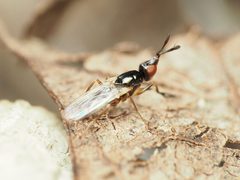
Prochyliza is a of waltzing flies in the Piophilidae, containing approximately 11 described . The genus is best known for the species Prochyliza xanthostoma, which exhibits extreme : males possess elongated, torpedo-shaped with long , while females have more conventional head proportions. Males engage in ritualized combat and on carrion, using their modified heads in territorial battles. The genus occurs primarily in the Nearctic region, with some species distributed in the Palearctic.
Pronunciation
How to pronounce Prochyliza: /proʊˈkaɪlɪzə/
These audio files are automatically generated. While they are not always 100% accurate, they are a good starting point.
Identification
Prochyliza can be distinguished from other Piophilidae by the pronounced in , particularly in P. xanthostoma where males have dramatically elongated, conical heads with originating from the tip. Males are larger than females and possess longer legs relative to body size. The slender body form and association with carrion separate them from the more compact cheese skippers (Piophila casei). -level identification requires examination of subtle characters including setal patterns and genitalic structures.
Images
Habitat
in this are associated with decomposing animal matter. Prochyliza xanthostoma has been observed on fish carcasses and winter-killed animal remains exposed by melting snow in riparian areas with cottonwood overstory. Carrion serves as both feeding substrate and mating arena.
Distribution
The occurs in North America (Nearctic) and Europe (Palearctic). Prochyliza xanthostoma is distributed across most of North America, particularly the eastern half of the continent. Palearctic records include Denmark, Norway, and Sweden. Other such as P. nigricornis and P. nigrimana have European distributions.
Seasonality
Prochyliza xanthostoma is active in early spring, appearing when melting snow exposes carcasses of winter-killed animals. Activity coincides with carrion availability during snowmelt periods.
Diet
Larvae feed on decomposing fatty tissues in carrion, often specializing on dried or desiccating remains after initial decomposition by other insects. likely feed on carrion fluids and associated microbial growth.
Behavior
Males of P. xanthostoma engage in elaborate involving movements and
Ecological Role
As carrion feeders, Prochyliza contribute to decomposition of animal remains, particularly during later stages when fatty tissues persist. They occupy a specialized in carrion , utilizing desiccating remains after blow flies and other early colonizers have departed.
Human Relevance
Prochyliza have no known economic importance to humans. They are not pests of stored products like the related cheese skippers (Piophila casei). The has been extensively studied in evolutionary research on , , and intralocus sexual conflict due to the extreme morphological differences between sexes in P. xanthostoma.
Similar Taxa
- Piophila caseiCheese skippers share Piophilidae but differ in compact body form, lack of extreme in structure, and association with dairy products and cured meats rather than exposed carrion.
- Protophormia/PhormiaBlow flies co-occur on carrion but belong to Calliphoridae, have metallic coloration, robust bodies, and lack the elongated male and slender leg proportions of Prochyliza.
More Details
Research significance
Prochyliza xanthostoma has become a model organism in studies of due to its extreme and measurable condition-dependent traits. Research has demonstrated that male length is highly condition-dependent and subject to strong female choice, with ejaculate feeding by females contributing to their reproductive success.
Intralocus sexual conflict
Studies of P. xanthostoma have revealed significant cross-sex genetic correlations that constrain the independent evolution of male and female traits, providing evidence for intralocus sexual conflict in sexually dimorphic .
Sources and further reading
- BugGuide
- Wikipedia
- GBIF taxonomy match
- iNaturalist taxon
- NCBI Taxonomy
- Catalogue of Life
- Bug Eric: Strange Flies on a Fish Carcass
- Ejaculate feeding and female fitness in the sexually dimorphic fly Prochyliza xanthostoma (Diptera: Piophilidae)
- INTRALOCUS SEXUAL CONFLICT AND THE GENETIC ARCHITECTURE OF SEXUALLY DIMORPHIC TRAITS IN PROCHYLIZA XANTHOSTOMA (DIPTERA: PIOPHILIDAE)
- SEXUAL SELECTION, GENETIC ARCHITECTURE, AND THE CONDITION DEPENDENCE OF BODY SHAPE IN THE SEXUALLY DIMORPHIC FLY PROCHYLIZA XANTHOSTOMA (PIOPHILIDAE)
- INTRALOCUS SEXUAL CONFLICT AND THE GENETIC ARCHITECTURE OF SEXUALLY DIMORPHIC TRAITS IN PROCHYLIZA XANTHOSTOMA (DIPTERA: PIOPHILIDAE)
- SEXUAL SELECTION, GENETIC ARCHITECTURE, AND THE CONDITION DEPENDENCE OF BODY SHAPE IN THE SEXUALLY DIMORPHIC FLY PROCHYLIZA XANTHOSTOMA (PIOPHILIDAE)