
Protopiophila
Duda, 1924
cheese skipper, antler fly
Species Guides
2- Protopiophila latipes(cheese skipper)
- Protopiophila litigata(Antler Fly)
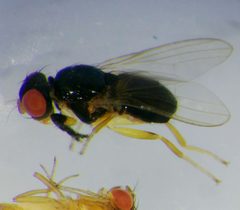
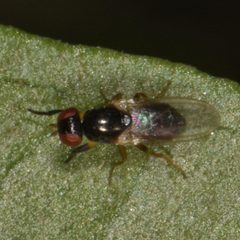
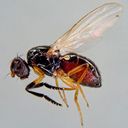
Protopiophila is a of piophilid flies commonly known as cheese skippers or antler flies. The genus comprises eleven described distributed across multiple continents. Some species, particularly P. litigata, have become model organisms for studying and evolution due to their specialized breeding on discarded cervid antlers. Other species such as P. latipes utilize decomposing animal carcasses as breeding substrates. The genus exhibits notable behavioral diversity in mating systems and larval ecology.
Pronunciation
How to pronounce Protopiophila: //ˌproʊtoʊˌpaɪoʊˈfaɪlə//
These audio files are automatically generated. While they are not always 100% accurate, they are a good starting point.
Identification
within Protopiophila are distinguished primarily by male genitalic structures and subtle differences in chaetotaxy. McAlpine (1977) provided a diagnostic key to species subsequently modified to accommodate P. litigata. P. litigata is distinguished from the widespread P. latipes by its exclusive association with discarded antlers rather than carrion, and by the presence of mate guarding in males. Accurate identification typically requires examination of dissected male terminalia.
Images
Habitat
Larval varies by : P. litigata develops exclusively in discarded antlers of cervid mammals (moose, deer), while P. latipes breeds on corpses in advanced decay. Antler quality varies with relative age inferred from chewing damage and larval , influencing development time and performance.
Distribution
Records from GBIF indicate presence in Denmark, Norway, and Sweden. P. litigata is documented from Ontario and Nova Scotia, Canada. P. australis occurs in Australia. The likely has broader Holarctic distribution with some southern hemisphere representation.
Host Associations
- Cervidae - Larval development substrate (antlers)Specific to P. litigata and related antler-breeding ; other species utilize carrion
Life Cycle
Larvae develop within solid organic substrates—discarded antlers for P. litigata, decomposing carcasses for P. latipes. Pupal development time varies with larval and antler quality; males typically pupate longer than females. Development time and survival differ among individual antlers based on resource availability and competition.
Behavior
Mating systems vary strikingly among . P. litigata exhibits elaborate courtship: males leap onto females, tap the with legs, stimulate the genital opening with and claspers until female genital extension (~4 min), followed by genital union (~10 min) and extended copulation (~87 min). Females move to antler regions with lower male during copulation. Post-copulation, females emit and ingest two spermatozoa-containing droplets—a unique among Diptera. Males guard females in tandem during oviposition (~29 min), using wings to repel rivals. Male-male wrestling occurs but takeovers are rare. P. latipes lacks mate guarding and breeds on carrion. Male epicuticular compounds are sexually dimorphic and subject to via female choice.
Ecological Role
Larvae contribute to decomposition of discarded antlers and carrion. P. litigata represents a specialized nutrient cycling for cervid antler . attraction to specific antlers indicates resource assessment capacity that may influence distribution.
Human Relevance
P. litigata serves as a model organism for evolutionary research, particularly regarding , reproductive aging, and condition-dependent trait expression. The ' predictable occurrence on moose antlers facilitates field study of wild . Some species in the related piophilid Piophila are cheese pests, but Protopiophila species have no documented economic impact.
Similar Taxa
- Piophila caseiAlso called cheese skipper; breeds on protein-rich substrates including cheese and cured meats; lacks antler specialization and mate guarding of P. litigata
- Protopiophila latipesSympatric breeding on carrion rather than antlers; lacks mate guarding; distinguished by preference and male terminalia
Sources and further reading
- BugGuide
- Wikipedia
- GBIF taxonomy match
- iNaturalist taxon
- NCBI Taxonomy
- Catalogue of Life
- COPULATION AND OVIPOSITION BEHAVIOUR OFPROTOPIOPHILA LITIGATA(DIPTERA: PIOPHILIDAE)
- Epicuticular Compounds of Protopiophila litigata (Diptera: Piophilidae): Identification and Sexual Selection Across Two Years in the Wild
- Natural variation in the growth and development of Protopiophila litigata (Diptera: Piophilidae) developing in three moose (Artiodactyla: Cervidae) antlers
- Shed antlers as a larval environment: antler quality and adult performance of wild Protopiophila litigata (Diptera: Piophilidae)
- Reproductive ageing and sexual selection on male body size in a wild population of antler flies (Protopiophila litigata)
- A NEW NEARCTIC SPECIES OF PROTOPIOPHILA DUDA (DIPTERA: PIOPHILIDAE), WITH NOTES ON ITS BEHAVIOUR AND COMPARISON WITH P. LATIPES (MEIGEN)