
Tabanus atratus
Fabricius, 1775
Black Horse Fly
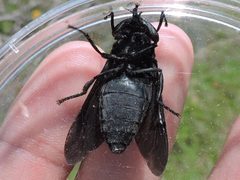
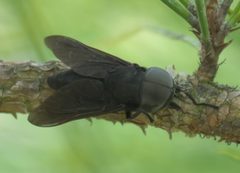
Tabanus atratus, commonly known as the black horse fly, is a large, all-black of horse fly in the Tabanidae. It is one of the largest horse flies in North America, with body lengths ranging from 20–25 mm. Females are blood-feeders with scissor-like mouthparts used to cut skin and lap blood, while males have reduced mouthparts and do not feed on blood. The species is recognizable by its uniform black coloration and distinctively hooked . Females lay in large masses of 100–1000 eggs near water's edge, with each female capable of producing three to four egg masses.
Pronunciation
How to pronounce Tabanus atratus: /tɑːˈbɑːnʊs əˈtreɪtəs/
These audio files are automatically generated. While they are not always 100% accurate, they are a good starting point.
Identification
Distinguished from other Tabanus by its all-black coloration (most have patterned or banded bodies), large size, and distinctly hooked . The combination of uniform black color, 20–25 mm length, and hooked antennal tips separates it from similar species. Tabanus americanus is larger (up to 30 mm) and has different color pattern. Esenbeckia incisuralis has striking emerald green and different body pattern.
Images
Appearance
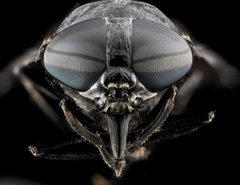
Large, robust fly with uniformly black body coloration. Body length 20–25 mm. are large and prominent; in males, eyes meet at the middle of the (), while in females eyes are separated (dichoptic). are distinctively hooked at the tip. Wings are clear to slightly smoky. Females possess prominent, blade-like scissor-shaped mouthparts adapted for cutting skin.
Habitat
Associated with aquatic and semi-aquatic environments. found in areas near water including lake edges, ponds, streams, and wet meadows. Larval development occurs in moist soil or mud near water bodies. The shows affinity for open, sunny near water where are available.
Distribution
Eastern and central United States. Records from Vermont southward through the eastern seaboard and westward through the central states. Distribution corresponds to availability of suitable aquatic breeding and mammalian .
Seasonality
active during summer months. Observations from June in Arkansas/Oklahoma and March in Florida suggest activity from spring through summer, with peak activity likely corresponding to warm weather when are abundant.
Diet
Females are obligate blood-feeders (), requiring blood meals for development. They feed on mammals, including livestock and humans, using scissor-like mouthparts to cut skin and lap blood. Males do not feed on blood; they have reduced mouthparts and feed on nectar or not at all.
Life Cycle
Complete with , larva, pupa, and stages. Females deposit eggs in masses of 100–1000 eggs on vegetation stems overhanging water. Eggs are initially white, gradually turning dark as they develop. Larvae develop in moist soil or mud near water, passing through multiple instars. occurs in soil. Adults emerge and disperse to find . time appears to be or depending on region.
Behavior
Females are persistent, aggressive biters when seeking blood meals. They are strong fliers and visually orient to large, dark moving objects (potential ). Oviposition involves careful placement of individual in stacked layers on stems overhanging water. are and most active in warm, sunny conditions.
Ecological Role
Females serve as biting pests of mammals and may act as mechanical of . The has been implicated as a potential vector of anthrax, worms, and . Larvae are predatory or scavenging in aquatic/semi-aquatic soils, contributing to nutrient cycling in these .
Human Relevance
Significant pest due to painful bites and persistent feeding . Bites can cause irritation, swelling, and secondary . Potential . Large size and all-black appearance make it conspicuous and often alarming to humans. Frequently photographed and documented by naturalists due to impressive size.
Similar Taxa
- Tabanus americanusLarger size (up to 30 mm, potentially world's largest horse fly); different color pattern and antennal structure
- Esenbeckia incisuralisHas striking emerald green rather than dark eyes; different body pattern and coloration
- Tabanus bovinusPrefers bovine and less harmful to humans; different body pattern with bands or spots rather than uniform black
Misconceptions
Online sources and field guides sometimes cite maximum lengths of 28–50 mm for T. atratus; these figures are unsubstantiated and likely reflect astonished reactions rather than careful measurement. The does not reach 50 mm (2 inches). T. americanus, not T. atratus, is North America's largest horse fly.
More Details
Egg mass characteristics
masses are structurally distinctive and constant enough to allow identification even without the female present. This was noted by Schwardt (1936) and represents an unusual case where eggs alone can be identified to species.
Sensory biology
Research has examined putative sensory structures associated with the food canal, suggesting specialized mechanoreceptive or chemoreceptive adaptations for location and blood-feeding.