
Tabanus americanus
Forster, 1771
American Horse Fly
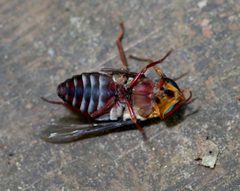
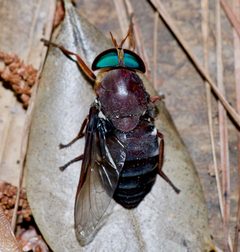
Tabanus americanus, the American horse fly, is a large horse fly in the Tabanidae. It is notable as potentially the world's largest horse fly, with body lengths reaching up to 30 mm. The species occurs in Canada and the United States, where are active in open pasture areas near livestock and water sources. Females require blood meals for development and are significant biting pests of cattle and other large mammals.
Pronunciation
How to pronounce Tabanus americanus: /təˈbeɪnəs əˌmɛrɪˈkeɪnəs/
These audio files are automatically generated. While they are not always 100% accurate, they are a good starting point.
Identification
Distinguished from other North American horse flies by its exceptional size—up to 30 mm body length, exceeding the 20–25 mm typical of the black horse fly (Tabanus atratus). Specific diagnostic features beyond size are not documented in available sources.
Images
Habitat
Open pasture areas where cattle or livestock are present. stay near ponds or other water sources, which serve as oviposition sites.
Distribution
Canada and the United States.
Diet
females are blood feeders on large mammals, particularly cattle. Adult males feed on nectar and other sugary substances. Specific larval diet is not documented.
Host Associations
- cattle - blood females bite cattle and other livestock
- large mammals - blood females require blood meals for development
Life Cycle
Females lay in masses near water edges or close to water sources. Larval development occurs in aquatic or semi-aquatic environments, though specific details on instar number or duration are not documented.
Behavior
Females are active biters and persistent pests of livestock. remain near open pastures and water sources. Oviposition occurs on vegetation overhanging or adjacent to water.
Ecological Role
females function as blood-feeding of large mammals. Larval is poorly documented but likely involves or scavenging in aquatic sediments typical of tabanid larvae.
Human Relevance
Significant economic pest of cattle due to biting activity, which causes irritation, reduced weight gain, and can transmit some . Bites to humans are painful but transmission to humans is not documented for this .
Similar Taxa
- Tabanus atratusSimilar large black horse fly, but T. americanus reaches 30 mm versus 20–25 mm for T. atratus; T. atratus has distinctly hooked
- Tabanus spp.Numerous overlap in range and ; size and specific antennal may aid separation
More Details
Size record
T. americanus may be the world's largest horse fly , with credible sources citing an upper size limit of 30 mm. This exceeds the commonly cited maximum of 28 mm for T. atratus and the typical 20–25 mm range for that species.