
Chrysops univittatus
Macquart, 1855
One-striped Deer Fly
Pronunciation
How to pronounce Chrysops univittatus: //ˈkrɪsɒps juːnɪvɪˈteɪtəs//
These audio files are automatically generated. While they are not always 100% accurate, they are a good starting point.
Identification
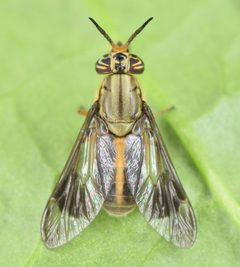
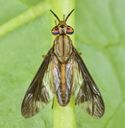
Distinguished from other Chrysops by the presence of a single prominent longitudinal stripe on the dorsum; specific diagnostic features relative to such as C. atlanticus and C. vittatus require examination of wing venation and abdominal patterning.
Images
Distribution
Eastern United States and southeastern Canada; confirmed occurrence in Vermont, southwestern Quebec, and surrounding regions.
Seasonality
Peak female abundance occurs in late July and early August in southwestern Quebec.
Diet
Females feed on nectar; blood-feeding on vertebrate occurs for development (anautogeny).
Life Cycle
Anautogenous; only one gonotrophic cycle recorded following ovary dissection. Number of correlates with body size as determined by wing length.
Behavior
Females exhibit nectar-feeding with 73% detected via cold anthrone test; 96% of females contain sperm with no difference between parous and nulliparous individuals.
Ecological Role
serve as potential through nectar feeding; females function as blood-feeding of vertebrates.
Human Relevance
Females bite humans and other vertebrates, causing irritation; specific status not documented in available sources.
Similar Taxa
- Chrysops atlanticusLaboratory studies conducted concurrently; distinguished by different abdominal patterning and preferences.
- Chrysops vittatusSimilar striped appearance; specific diagnostic differences in stripe configuration and wing markings require expert examination.
Sources and further reading
- BugGuide
- Wikipedia
- GBIF taxonomy match
- iNaturalist taxon
- NCBI Taxonomy
- Catalogue of Life
- Grasshoppers of Colorado
- Striped Sand Grasshopper
- Names Matter | Bug Squad
- Culex univittatus - Entomology Today
- Culex univittatus - Entomology Today
- Mosquito Migration: Study Finds More High-Altitude Dispersal of Disease Vectors in Africa
- ASPECTS OF THE BIOLOGY OF FEMALE CHRYSOPS UNIVITTATUS (DIPTERA: TABANIDAE) IN SOUTHWESTERN QUEBEC
- Observation on the Laboratory Life History of Chrysops atlanticus, C. univittatus and C. vittatus (Diptera: Tabanidae)