
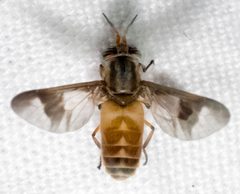
Chrysops atlanticus
Pechuman, 1949
Atlantic Deer Fly
Pronunciation
How to pronounce Chrysops atlanticus: /ˈkrɪsɒps ætlænˈtɪkəs/
These audio files are automatically generated. While they are not always 100% accurate, they are a good starting point.
Images
Distribution
United States. Specific records include Vermont.
Life Cycle
are laid in masses on substrate surface. Larvae pass through 4-6 instars with variable developmental periods: 1st instar 1-2 days, 2nd instar 2-3 days, 3rd instar 2-3 days, 4th instar 3-5 days, 5th instar 4-5 days, 6th instar 5-6 days (when present). Pupal stage lasts 6-8 days. Total development from egg to is approximately 20-30 days under laboratory conditions at 25°C. Adults emerge in morning hours.
Behavior
occurs in morning hours.
Human Relevance
Deer flies in the Chrysops are known for their painful bites to humans and other mammals.
Sources and further reading
- BugGuide
- Wikipedia
- GBIF taxonomy match
- iNaturalist taxon
- Grasshoppers of Colorado
- Bug Eric: What the Insects Have Taught Me
- Bug Eric: Wasp Wednesday: Great Golden Digger
- Bug Eric: May 2020
- ID Challenge #2 | Beetles In The Bush
- Observation on the Laboratory Life History of Chrysops atlanticus, C. univittatus and C. vittatus (Diptera: Tabanidae)