
Paragus
Latreille, 1804
Grass Skimmer Flies
Species Guides
2- Paragus angustifrons(Narrow-faced Grass Skimmer)
- Paragus haemorrhous(Black-backed Grass Skimmer)
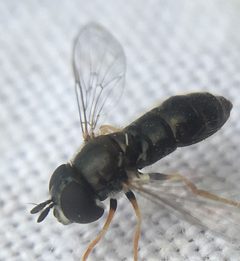
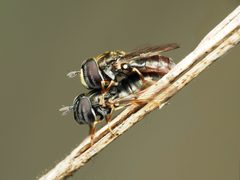
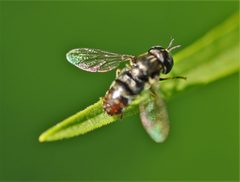
Paragus is a of hoverflies ( Syrphidae) comprising over 100 distributed worldwide except Antarctica. The genus is notable for its predatory larvae that feed on aphids, making it an important group for . are frequently observed visiting small flowering plants for nectar and pollen. Several subgenera are recognized, including Afroparagus, Pandasyopthalmus, Paragus, and Serratoparagus.
Pronunciation
How to pronounce Paragus: //ˈpæ.ɹə.ɡəs//
These audio files are automatically generated. While they are not always 100% accurate, they are a good starting point.
Images
Habitat
Larvae develop in colonies on various plants, including fruit trees, reeds (Phragmites), and agricultural crops. frequent open where small flowering plants are abundant. Specific habitat associations vary by ; for example, Paragus hyalopteri has been collected on Phragmites australis in association with aphid colonies.
Distribution
Worldwide distribution except Antarctica. Documented from the Palearctic (Europe, Iran), Nearctic (North America), Afrotropical (Ghana, Réunion), and other regions. Distribution records include Denmark, Norway, Sweden, Vermont (USA), and the US broadly.
Diet
Larvae are obligate of aphids (Aphididae). Documented prey includes Hyalopterus pruni (mealy plum aphid), Toxoptera aurantii (black citrus aphid), and other . feed on nectar and pollen from small flowering plants such as Polygonum (knotweed), Anagallis arvensis (Scarlet Pimpernel), Veronica persica (Common Field Speedwell), and Medicago lupulina (Black Medick).
Host Associations
- Hyalopterus pruni - preymealy plum aphid; documented for P. hyalopteri
- Toxoptera aurantii - preyblack citrus aphid; documented for P. borbonicus on cocoa in Ghana
- Phragmites australis - larval development site for P. hyalopteri
- Arundo donax - documented for P. hyalopteri
- Theobroma cacao - cocoa plantations; documented for P. borbonicus in Ghana
Life Cycle
Complete with four stages: , three larval instars, , and . The full has been described in detail for Paragus hyalopteri, including egg , all three larval stages, and puparium structure. Larvae develop within colonies on plants.
Behavior
are diligent foragers on small flowering plants, often overlooked due to their diminutive size. Larvae are active within colonies. Female oviposition occurs in or near aphid colonies to ensure larval food availability.
Ecological Role
Important agents of pests in agricultural and natural . Contributes to natural pest suppression in crops including fruit trees and cocoa. serve as of small, often overlooked flowering plants.
Human Relevance
Valued as agents for agricultural pest management, particularly for control in orchards and field crops. The has been studied specifically for its potential in programs.
Similar Taxa
- other Syrphidae generaParagus can be distinguished from similar small hoverflies by a combination of morphological characters including facial features and male genitalia structure; precise identification often requires examination of terminalia
More Details
Subgeneric classification
The is divided into four subgenera: Afroparagus (Afrotropical ), Pandasyopthalmus (includes Holarctic P. crenulatus group), Paragus (largest subgenus, worldwide), and Serratoparagus (characterized by serrated abdominal margins). This classification reflects biogeographic and morphological patterns but may be revised with further study.
Taxonomic research status
The has undergone recent revision in the New World, with six new Nearctic described. The stages of only about 9 of 27 known larvae had been described prior to detailed studies of P. hyalopteri, indicating significant gaps in larval knowledge.
Sources and further reading
- BugGuide
- Wikipedia
- GBIF taxonomy match
- iNaturalist taxon
- NCBI Taxonomy
- Catalogue of Life
- Not Just the Bees | Bug Squad
- Exploring poorly researched insect fauna: how plants amplify the net ecological benefit for inconspicuous invertebrate communities - Buglife Blog - Buglife
- The Brilliance of Brownfields - Buglife Blog - Buglife
- Bug Eric: Home Bioblitz, Ongoing
- Bug Eric: 2021
- Morphology of the immature stages of the hoverfly Paragus (Paragus) hyalopteri Marcos-García & Rojo, 1994 (Diptera, Syrphidae), predator of the mealy plum aphid Hyalopterus pruni (Hemiptera, Aphididae)
- REVISION OF THE NEW WORLD SPECIES OF PARAGUS LATREILLE (DIPTERA: SYRPHIDAE)
- Biology of Paragus borbonicus (Diptera: Syrphidae) as Predator of Toxoptera aurantii (Homoptera: Aphididae) Attacking Cocoa in Ghana
- The genus Paragus Latreille (Diptera: Syrphidae) in Iran, with the description of a new species
- Whole genome sequencing of Phomopsis asparagi reveals molecular basis of asparagus stem blight pathogenesis.