
Paragus haemorrhous
Meigen, 1822
Black-backed Grass Skimmer, Common Grass Skimmer
Paragus haemorrhous is a small hoverfly distributed across Europe, Africa, and the Nearctic. are commonly found on flowers where they feed on nectar and pollen. The larvae are predatory, feeding on aphids on low herbaceous plants. The species is active from May through September and occupies diverse open including grasslands, heathlands, and forest edges.
Pronunciation
How to pronounce Paragus haemorrhous: //ˈpɛɹ.ə.ɡəs ˌhiː.mɔːˈɹoʊ.s//
These audio files are automatically generated. While they are not always 100% accurate, they are a good starting point.
Identification
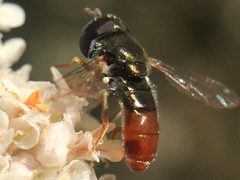
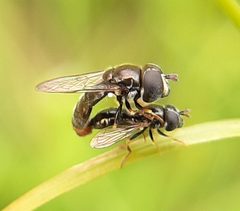
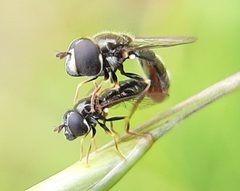
Males identifiable by abdominal coloration (segments 3–5 red-orange to dark red) and genitalia structure; females indistinguishable from . Distinguished from other Paragus by combination of entirely black scutellum, yellow with black stripe, and specific leg coloration pattern. See specialized keys for definitive determination.
Images
Appearance
Small hoverfly measuring 4.3–5.9 mm. yellow with a black stripe in both sexes. Third antennal joint reddish below. uniformly pilose. Scutellum entirely black. : segment 1 black and well-developed; segment 2 black or with red margin; segments 3–5 usually red-orange to dark red in males. Wings hyaline with brownish grey stigma. Legs yellow and light brownish yellow; basal half of black; hind tibia usually with half yellow-orange.
Habitat
Unimproved grassland, heathland, garrigue, dune grassland, open areas and pathsides in forest up to the Larix/Pinus uncinata zone, fen meadow. Occupies diverse open with flowering vegetation.
Distribution
Palearctic: Fennoscandia south to Iberia and Mediterranean basin, east through Central and Southern Europe to European Russia, including Israel and Turkey, Ireland. Nearctic: Yukon south to Rica. Afrotropical region: parts of Africa.
Seasonality
active May to September.
Diet
feed on nectar and pollen from flowers including umbellifers, Calluna, Jasione montana, Matricaria, Origanum, Polygonum, Potentilla, Solidago, and Stellaria. Larvae are on aphids on low herbaceous plants.
Life Cycle
Complete with predatory larval stage feeding on aphids. Specific developmental stages and strategy not documented in available sources.
Behavior
are flower visitors, obtaining energy from nectar and protein from pollen. period spans late spring through early autumn.
Ecological Role
contribute to pollination through flower visitation. Larvae provide of aphids, functioning as natural pest control agents in grassland and open .
Human Relevance
Beneficial due to by larvae, supporting natural pest control in agricultural and natural settings. serve as .
Similar Taxa
- Paragus tibialisHistorically confused; molecular and morphological evidence suggests P. haemorrhous, P. coadunatus, and P. ascoensis may be synonyms of P. tibialis, though this remains taxonomically contested
- Other Paragus speciesFemales cannot be identified to level, requiring male genitalia examination for differentiation
More Details
Taxonomic Uncertainty
Rojo et al. (2006) proposed based on morphological and molecular evidence that Paragus haemorrhous, Paragus coadunatus, and Paragus ascoensis are synonyms of Paragus tibialis, though this synonymy may not be universally accepted.
Identification Limitations
Females of Paragus cannot be reliably identified to species; only males can be determined through examination of genitalia structure.
Sources and further reading
- BugGuide
- Wikipedia
- GBIF taxonomy match
- iNaturalist taxon
- NCBI Taxonomy
- Catalogue of Life
- Not Just the Bees | Bug Squad
- Bug Eric: Home Bioblitz, Ongoing
- Bug Eric: 2021
- Exploring poorly researched insect fauna: how plants amplify the net ecological benefit for inconspicuous invertebrate communities - Buglife Blog - Buglife
- The Brilliance of Brownfields - Buglife Blog - Buglife