
Eupeodes snowi
(Wehr, 1924)
Snow's Aphideater
Eupeodes snowi is a of syrphid fly, commonly known as Snow's Aphideater, in the Syrphidae. As a member of the Syrphinae , its larvae are . The species is part of a diverse of hover flies that serve as important agents and .
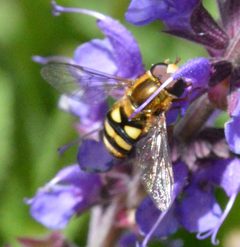
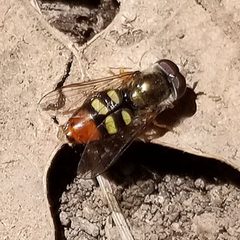
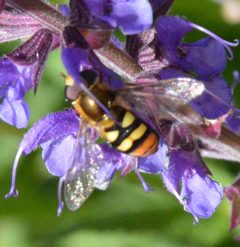
Pronunciation
How to pronounce Eupeodes snowi: //juːpiˈoʊdiːz ˈsnoʊ.aɪ//
These audio files are automatically generated. While they are not always 100% accurate, they are a good starting point.
Identification
As a of Eupeodes, likely display the characteristic yellow and black abdominal banding pattern common to the , though specific distinguishing features from are not documented in available sources. Adults possess the typical syrphid : large that nearly meet in females and meet at the top of the in males, short , and a single pair of wings with . The is retractable with a sponge-like tip for feeding on nectar.
Images
Distribution
Records indicate presence in North America, with specific observations from the southwestern United States including Arizona and New Mexico.
Diet
Larvae are , consistent with the of the Syrphinae . feed on nectar and pollen.
Life Cycle
Females lay in or near colonies. Larvae pass through three instars before pupating. The pupal stage is a convex, pear-shaped structure attached to vegetation.
Behavior
exhibit hovering capability. Larvae are cryptic, often resembling discolored patches on leaves or shed pollen cones.
Ecological Role
Larvae function as , providing of pest . serve as while visiting flowers for nectar.
Human Relevance
Beneficial insect in gardens and agricultural settings due to by larvae. may be mistaken for bees or due to mimicry.
Similar Taxa
- Eupeodes volucrisSimilar yellow and black banded abdominal pattern; requires examination of specific morphological details for separation
- Eupeodes americanusOverlapping distribution and similar general appearance; precise identification requires examination