
Eupeodes perplexus
(Osburn, 1910)
bare-winged aphideater
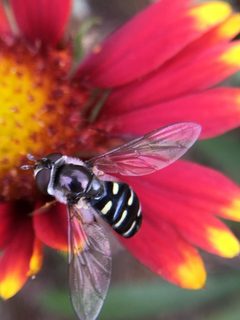
Eupeodes perplexus, commonly known as the bare-winged aphideater, is a hoverfly native to North America. The species is notable for its distinctive wing venation and abdominal patterning. are nectar feeders, while larvae are predatory, consuming aphids and scale insects. The species is part of the diverse syrphid fauna that contributes to both pollination and in various .
Pronunciation
How to pronounce Eupeodes perplexus: /juːˈpiːoʊdiːz pərˈplɛksəs/
These audio files are automatically generated. While they are not always 100% accurate, they are a good starting point.
Identification
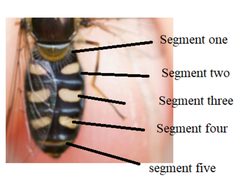
Distinguished from similar by abdominal spot pattern and wing venation. The abdominal spots are yellow, finger-like, wide, and curved, interrupted in the middle, and do not reach the lateral margins—this contrasts with Melangyna lasiophthalma, whose abdominal spots reach the lateral margin. The third wing (R4+5) shows only slight curvature, unlike Scaeva pyrastri where this vein has a long, moderately deep curvature. Scaeva pyrastri also has more curved and slightly constricted abdominal spots. The bare (lacking pile) and specific pattern of facial markings provide additional diagnostic characters.
Images
Appearance
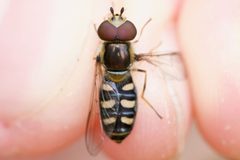
Medium-sized hoverfly with characteristic wing and abdominal features. hemispherical with slightly concave, tuberculate below ; face whitish-yellow with black cheeks and dark vitta over . Antennae short with exceptionally large third segment (), oval in shape; dark crescent-shaped spot over base of each antenna. bare. with white pile on metasternum and ; scutellum raised, exposing . anepisternum, meron, and metepisternum bare. Male scutellum with yellow, black, or mixed pile; female scutellum mostly black-piled. with yellow, finger-like, wide, curved spots interrupted in middle; first segment narrow and entirely black; second segment spots do not reach sides; female abdominal bands broader; fifth segment yellow, sometimes with small median black spot; spots on segments three and four slightly lunate with margins of fourth and fifth segments narrowly yellow. Wings hyaline with third longitudinal (R4+5) only slightly curved; marginal (r1) open with anterior cross-vein (R-M) located near base of ; stigma thin, long, and brown. Legs mainly pale reddish with black bases of ; hind femora black on basal half or more.
Distribution
Nearctic distribution across North America and Canada.
Diet
feed on nectar. Larvae feed on aphids and scale insects.
Ecological Role
contribute to pollination through nectar feeding. Larvae function as of aphids and scale insects, potentially providing of these plant pests.
Human Relevance
The may contribute to natural suppression of and insect in agricultural and horticultural settings, though specific documented impacts are not detailed in available sources.
Similar Taxa
- Melangyna lasiophthalmaSimilar appearance but distinguished by abdominal spots reaching lateral margins, which they do not in E. perplexus
- Scaeva pyrastriSimilar appearance but distinguished by long, moderately deep curvature of third wing (R4+5) and more curved, slightly constricted abdominal spots
Sources and further reading
- BugGuide
- Wikipedia
- GBIF taxonomy match
- iNaturalist taxon
- NCBI Taxonomy
- Aphytis Project Final Report | Entomology Research Museum
- Digging Deep: The Secrets Within Termite Nests
- Bug Eric: Wasp Wednesday: A Real Surprise
- Putting Bumble Bees in a Box Might Help Scientists Study Their Nesting Ecology
- Predator Satiation | Beetles In The Bush
- Bug Eric: August 2012