
Volucella facialis
Williston, 1882
Yellow-faced Swiftwing
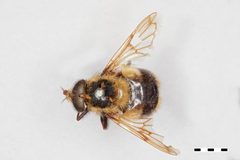
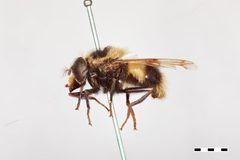
Volucella facialis is a of hoverfly in the Syrphidae, commonly known as the Yellow-faced Swiftwing. It belongs to a noted for of bumble bees and . Like other Volucella species, it is an , laying in the nests of social bees and wasps where larvae consume . The species is found in North America, with records from Vermont and other parts of the United States.
Pronunciation
How to pronounce Volucella facialis: /vɔˈluː.sɛl.lə fəˈtʃiː.ə.lɪs/
These audio files are automatically generated. While they are not always 100% accurate, they are a good starting point.
Identification
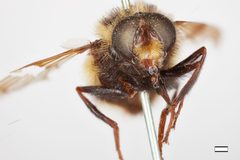
Distinguished from bumble bees by having only one pair of wings (flies) versus two pairs (bees), short stubby versus longer elbowed antennae, and the absence of a stinger. Separated from other Volucella by the yellow and specific pattern details. The Volucella is the only member of tribe Volucellini in North America.
Images
Appearance
A large hoverfly with a robust body. As the suggests, the is yellow. The overall coloration typically mimics bumble bees, with a furry appearance created by dense setae. Like all syrphid flies, it possesses only one pair of functional wings (the hind wings reduced to small knob-like ), short , and large . The body is generally larger than many other hoverfly .
Habitat
Found in areas where and nests occur, including gardens, meadows, woodlands, and forest edges. frequent flowers for nectar and pollen.
Distribution
Recorded from Vermont and other parts of the United States. The Volucella has broader distribution in North America, Europe, and Asia.
Diet
feed on nectar and pollen from flowers. Larvae are in nests of social bees and , where they consume larvae and nest provisions.
Host Associations
- Social bees and wasps - Larvae develop in nests
Life Cycle
Females enter nests of social Hymenoptera to lay . Larvae develop as , feeding on larvae and stored provisions. occurs within the host nest.
Behavior
engage in flower-visiting , hovering at blossoms to feed on nectar and pollen. Females exhibit nest-entering behavior to oviposit in colonies. The is a Batesian mimic, gaining protection from by resembling stinging bees and .
Ecological Role
contribute to pollination through flower visitation. As , larvae represent a natural control mechanism for social and colonies.
Human Relevance
are harmless that cannot sting. The has no significant negative economic impact; larval inquilinism is a natural phenomenon rather than a managed pest issue.
Similar Taxa
- Volucella bombylansClosely related congeneric ; V. facialis distinguished by yellow
- Bombus spp. (bumble bees)Mimicry target; distinguished by wing count, structure, and stinger presence
- Copestylum mexicanum (Mexican cactus fly)Formerly placed in Volucella; now in related Copestylum
More Details
Taxonomic note
Volucella bombylans was long considered the only valid North American in the , but V. facialis is recognized as a distinct species. Recent evidence suggests V. bombylans may represent a .
Mimicry system
Exemplifies , where a palatable evolves to resemble a defended model (stinging Hymenoptera) to avoid .
Sources and further reading
- BugGuide
- GBIF taxonomy match
- iNaturalist taxon
- NCBI Taxonomy
- Catalogue of Life
- This Hover Fly Engages in Identity Theft | Bug Squad
- Bug Squad
- Hide the Cactus! | Bug Squad
- A bee or not a bee? That is the question! Syrphid fly, Volucella bombylans — Bug of the Week
- Meet six unsung heroes of the pollination world - Buglife Blog - Buglife
- Archive — Bug of the Week