
Cheilosia grossa
(Fallén, 1817)
Large Bulb Fly, Foxy Bulb Fly
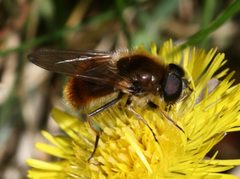
A large, robust hoverfly in the Syrphidae, widespread across Europe. are active in early spring, visiting willow catkins and other early-flowering plants. The species is notable for its phytophagous larvae that tunnel within thistle stems and roots, causing characteristic plant damage. Males exhibit distinctive hovering at height, occasionally forming loose swarms.


Pronunciation
How to pronounce Cheilosia grossa: //kaɪˈloʊʒiə ˈɡrəʊsə//
These audio files are automatically generated. While they are not always 100% accurate, they are a good starting point.
Identification
Distinguished from the similar Cheilosia chrysocoma by: segment 3 brown to black (yellow in C. chrysocoma); foxy-tawny (pale yellow in C. chrysocoma); all tarsal segments black (at least some segments yellowish in C. chrysocoma). The combination of large size, dark antennae, and orange tibiae separates it from most other European Cheilosia. Larval damage to thistles—multiple sprouting stems and stunted growth—provides indirect evidence of presence.
Images
Appearance
Habitat
Deciduous forest clearings and rides, woodland edges, poorly drained pastures, damp meadows, and heathlands. Strongly associated with areas supporting thistle , particularly marsh thistle and spear thistle. Open with early spring flowering vegetation.
Distribution
Widespread across the Palearctic: most of Europe including UK and Ireland, Northern and Central Europe; extends to western North America. Present from lowlands to higher altitudes, with activity period shifting later at elevation.
Seasonality
active March through May, peaking late March to early April. At higher altitudes, period extends into later spring months. Larvae present in thistle stems from spring through late summer. Pupae overwinter in soil, with adults emerging the following spring.
Diet
feed on nectar from early spring flowers including Salix (willows, especially S. caprea), Anemone nemorosa, Corylus, Prunus spinosa, Ranunculus, Taraxacum, and Tussilago. Larvae are phytophagous, tunneling in roots and stems of thistles (Cirsium ).
Host Associations
- Cirsium palustre - larval marsh thistle; larvae tunnel in roots and stems
- Cirsium vulgare - larval spear thistle; larvae tunnel in roots and stems
- Salix caprea - nectar sourcegoat willow; major early spring food source
- Corylus avellana - nectar sourcehazel
- Prunus spinosa - nectar sourceblackthorn
Life Cycle
with pupal stage. emerge in early spring (March–April). Females lay on early flowering thistle spikes. Larvae hatch within days and immediately tunnel into thistle roots and stems, feeding throughout spring and summer. Larvae exit plants in late August, drop to ground, and pupate in soil. Adults emerge following spring after pupal .
Behavior
Males hover at height over open ground, occasionally forming loose swarms 2–6 meters above ground level. fly high and fast, making direct observation challenging. Females search for suitable thistle for oviposition. Larval feeding induces host plants to produce multiple stems and show stunted growth—visible signs of .
Ecological Role
function as of early spring flowering woody plants and herbs, particularly willows. Larvae act as specialized herbivores on thistles, potentially influencing plant and vegetation structure in wetland and meadow .
Human Relevance
Larvae sometimes considered minor agricultural pests when thistles are cultivated, though economic impact generally negligible. sequenced (2024) as part of biodiversity initiatives. contribute to early spring pollination services in natural and semi-natural .
Similar Taxa
- Cheilosia chrysocomaSimilar size and preference; distinguished by yellow segment 3, pale yellow , and yellowish tarsal segments
- Cheilosia illustrataAlso large and furry, but has distinctively banded and different antennal coloration
- Cheilosia bergenstammiSimilar spring but smaller, with different leg coloration and less robust build
More Details
Genome sequencing
Whole sequenced in 2024: assembly size 362.40 Mb, 6 chromosomal pseudomolecules (5 + X ), 20,196 protein-coding genes predicted.
Larval damage signs
Infested thistles exhibit characteristic : sprouting of multiple stems from root crown, stunted growth, and sometimes visible tunnel exit holes. These signs persist after larvae have left to pupate.
Sources and further reading
- BugGuide
- Wikipedia
- GBIF taxonomy match
- NCBI Taxonomy
- Bug Eric: Wasp Wednesday: Pepsis grossa
- Do Chestnut, Lemon, or Peppermint Scents Repel Spiders?
- Another Pest of Pollinators: Small Hive Beetle Management in Honey Bee Colonies
- MycoKeys | Blog - Part 6
- Bug Eric: Tarantula Hawks
- biodiversity hotspot | Blog
- The genome sequence of a hoverfly, Cheilosia grossa (Fallén, 1817).