
Cheilosia
Meigen, 1822
Blacklets
Species Guides
4- Cheilosia albitarsis
- Cheilosia grossa(Large Bulb Fly)
- Cheilosia pallipes(yellow-shouldered blacklet)
- Cheilosia shannoni(Shannon's Blacklet)
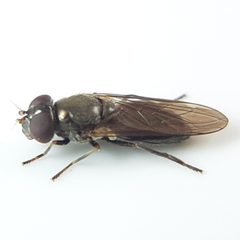
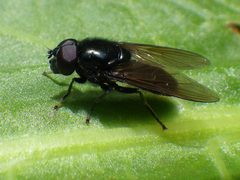
Cheilosia is a large of hoverflies (Syrphidae) commonly known as blacklets. Most exhibit predominantly black or dull coloration without the bright patterns seen in many other hoverflies. It is one of the most species-diverse genera in the . Larval varies by species: some feed in plant stems, others in fungi, and several species have been developed as agents for plants.
Pronunciation
How to pronounce Cheilosia: /kaɪˈloʊsiə/
These audio files are automatically generated. While they are not always 100% accurate, they are a good starting point.
Identification
Distinguished from other hoverfly by predominantly black or dull coloration lacking bright patterns. Cheilosia grossa specifically can be identified by orange tibiae, black , and furry appearance combined with early spring period.
Images
Appearance
Most are black or largely uncoloured, lacking the bright colours and patterns typical of many hoverfly species. Specific species such as Cheilosia grossa are described as large and fluffy with orange tibiae, black , and a furry appearance.
Habitat
varies by . Cheilosia grossa occurs in woodland rides and edges, heathlands, and damp meadows, particularly where thistles are abundant. Species used for inhabit areas with their plants (hawkweeds, Hieracium spp.).
Distribution
Records from Denmark, Norway, Sweden, Vermont (USA), and other US locations. Cheilosia grossa is distributed across the UK, Ireland, Northern and Central Europe. Some have been introduced or evaluated for introduction to New Zealand for .
Seasonality
Cheilosia grossa is active March-May, peaking late March-early April. Seasonality for other varies and is poorly documented for many.
Diet
of Cheilosia grossa visit willows (Salix caprea) and other early spring flowering plants including blackthorn, colt's-foot, and dandelion. Larvae are phytophagous, feeding on thistle roots and stems (Cirsium palustre, C. vulgare) or hawkweed roots and crowns (Hieracium spp.). Some have larvae that feed in fungi.
Host Associations
- Cirsium palustre (marsh thistle) - larval Cheilosia grossa
- Cirsium vulgare (spear thistle) - larval Cheilosia grossa
- Salix caprea (goat willow) - food sourceCheilosia grossa
- Hieracium spp. (hawkweeds) - larval C. urbana and C. psilophthalma
Life Cycle
Cheilosia grossa: females lay on early flowering thistle spikes in spring; larvae emerge within days and tunnel in thistle roots and stems; larvae exit roots in late August and overwinter as pupae in soil, emerging as the following spring. Other : larvae feed in plant stems or fungi; specific details vary by species and are unknown for many.
Behavior
Cheilosia grossa males hover at height over open ground and can form loose swarms at 2-6 metres above ground. tend to fly high, making them difficult to observe. Larval of thistles is indicated by sprouting of multiple stems and stunted plant growth.
Ecological Role
Phytophagous larvae act as herbivores on plants; serve as of early spring flowering plants. Some function as agents for plants.
Human Relevance
Cheilosia urbana and C. psilophthalma have been approved and released in New Zealand as agents for hawkweeds (Hieracium spp.).
Similar Taxa
- Other hoverfly generaCheilosia lack the bright colours and patterns typical of many hoverfly species, appearing predominantly black or dull.
More Details
Species diversity
Cheilosia is one of the most -diverse of hoverflies, though the of many species remains little understood.
Larval habitat variation
Larval varies considerably: some feed in plant stems, others in fungi, with specific associations documented for only a minority of .
Sources and further reading
- BugGuide
- Wikipedia
- GBIF taxonomy match
- iNaturalist taxon
- NCBI Taxonomy
- Catalogue of Life
- Biology and life history of Cheilosia urbana (Meigen) and Cheilosia psilophthalma (Becker), two sympatric hoverflies approved for the biological control of hawkweeds (Hieracium spp.) in New Zealand
- Host range of Cheilosia urbana (Meigen) and Cheilosia psilophthalma (Becker) (Diptera: Syrphidae), candidates for the biological control of invasive alien hawkweeds (Hieracium spp., Asteraceae) in New Zealand
- The genome sequence of a hoverfly, Cheilosia grossa (Fallén, 1817).
- Resolving the Taxonomy of Mountain Syrphidae (Diptera) in the Iberian Peninsula: The Species Group of Cheilosia melanura Becker, 1894.