
Cheilosia albitarsis
Meigen, 1822
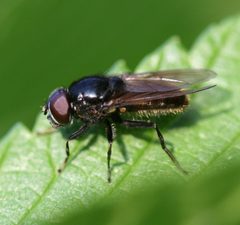
Cheilosia albitarsis is a large, abundant European hoverfly with a period from April to June, extending into July at higher elevations. are strongly associated with buttercup flowers (Ranunculus), which also serve as the larval plant. The occupies diverse including woodland clearings, agricultural land, and montane pastures. It is widely distributed throughout the Palearctic region.

Pronunciation
How to pronounce Cheilosia albitarsis: //ˈkaɪ.ləˌsiː.ə ˌæl.baɪˈtɑr.sɪs//
These audio files are automatically generated. While they are not always 100% accurate, they are a good starting point.
Identification
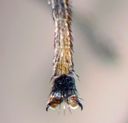
Males distinguished by square-shaped tarsomere 5 on fore and black-haired dorsum. Females identified by pale middle tarsomeres on fore tarsus, non-protruding mouth margin, and with hairs equal in length to arista diameter. Antero-lateral black hairs on tergite 2 present in males. Larval illustrated by Rotheray (1993).
Images
Appearance
A large, broadly-built Cheilosia with wing length 7–9.5 mm. Male: dorsum covered with black hairs; fore with tarsomere 5 square in shape; tergite 2 with antero-lateral black hairs. Female: fore tarsus with middle tarsomeres pale; mouth margin not protruding downward; with hair length equal to diameter of arista.
Habitat
Woodland and forest clearings, agricultural land, montane pasture, and subalpine pasture. Occupies both lowland and elevated environments.
Distribution
Throughout the Palearctic region. Documented presence in Belgium (Flanders, Brussels-Capital Region, Flemish Region, Walloon Region).
Seasonality
period April to June, extending into July at higher altitudes.
Host Associations
- Ranunculus - larval plantButtercup flowers; also visit these flowers
Life Cycle
Larval stage develops in buttercup (Ranunculus) plants. Specific developmental details beyond association not documented.
Behavior
visit flowers for nectar and pollen. Strongly associated with buttercup flowers in spring.
Ecological Role
contribute to pollination of visited flowers. Larval association with buttercups suggests potential herbivory or internal feeding within plant tissues.
Similar Taxa
- Other Cheilosia speciesRequires examination of tarsal characters, thoracic hair color, and for differentiation; C. albitarsis distinguished by specific combinations of pale tarsomeres in females and square tarsomere 5 in males
More Details
Taxonomic Note
iNaturalist lists this at 'complex' rank, though all authoritative sources (Catalogue of Life, GBIF, NCBI) recognize it as a valid .
Flower Associations
recorded visiting: white umbellifers, composites, Ajuga, Allium ursinum, Caltha, Crataegus, Matricaria, Potentilla, Prunus spinosa, Ranunculus, Sorbus, and Stellaria.