
Chalcosyrphus vecors
(Osten Sacken, 1875)
Orange-hipped Leafwalker
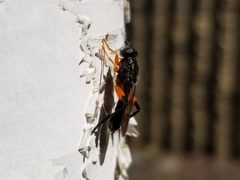
Chalcosyrphus vecors, commonly known as the Orange-hipped Leafwalker, is a of syrphid fly ( Syrphidae) found throughout North America. It belongs to the subgenus Xylotomima and was originally described by Osten Sacken in 1875. Like other members of its , this species is associated with dead and decaying wood, where its larvae develop as saprophages.
Pronunciation
How to pronounce Chalcosyrphus vecors: //kælkəˈsɪrfəs ˈviːkɔrs//
These audio files are automatically generated. While they are not always 100% accurate, they are a good starting point.
Identification
The Orange-hipped Leafwalker can be distinguished from other Chalcosyrphus by its combination of black body coloration with orange or reddish abdominal markings, absence of steel blue highlights (C. chalybeus), and lack of red abdominal markings (C. piger). The enlarged, spinose metafemora are characteristic of the but may show species-specific differences in degree of development. Males are identifiable by their . Definitive identification to species typically requires examination of microscopic characters.
Images
Habitat
Associated with dead and decaying wood, including recently fallen or wind-thrown trees. are frequently observed on the trunks and branches of dead hardwoods and conifers. The appears to favor moist woodland environments where dead wood accumulates.
Distribution
North America, with records from Canada and the United States. The has been documented across a broad geographic range, though it is described as uncommon in occurrence.
Diet
feed on pollen. Larvae are saprophages, developing in decaying wood rather than being predatory.
Host Associations
- Dead and decaying wood - larval developmentLarvae develop as saprophages in rotting wood of various tree .
Life Cycle
Complete with , larval, pupal, and stages. Larvae develop within decaying wood, feeding on decomposing wood material. occurs within the wood substrate. Adults emerge and are active during warmer months, with timing varying by latitude.
Behavior
are frequently observed on the trunks and branches of dead trees, repeatedly returning to the same substrate when disturbed. This , combined with their robust body form, can cause them to be mistaken for robber flies (Asilidae) or other predatory flies associated with dead wood. The enlarged metafemora with spines and curved tibiae suggest adaptations for gripping wood surfaces. Adults are capable of hovering typical of syrphid flies.
Ecological Role
As larvae, contributes to wood decomposition and nutrient cycling in forest . may serve as through their pollen-feeding . The is part of the diverse of saproxylic (dead wood-dependent) insects that contribute to forest biodiversity.
Human Relevance
No significant direct economic importance. Like other hover flies, may contribute to pollination of wild and cultivated plants. The is of interest to entomologists studying saproxylic insect and syrphid diversity.
Similar Taxa
- Chalcosyrphus chalybeusSimilar robust black body form, but C. chalybeus exhibits distinctive steel blue metallic highlights not present in C. vecors.
- Chalcosyrphus pigerSimilar overall appearance, but C. piger typically shows red abdominal markings, whereas C. vecors has orange or reddish hip markings without the same pattern.
- Xylota speciesRelated with similar wood-associated habits; some may resemble C. vecors in general gestalt, though Xylota species generally lack the same degree of metafemoral enlargement.
- Andrenosoma fulvicaudum and other Laphriinae robber fliesThese robber flies share similar dead wood association and robust black body form, leading to potential confusion; however, they possess very different with prominent concave facial profile and strong predatory mouthparts.
More Details
Taxonomic history
Originally described as Xylota vecors by Osten Sacken in 1875, later transferred to the Chalcosyrphus. The is currently placed in the subgenus Xylotomima.
Metafemoral modifications
The enlarged, ventrally spinose metafemora with curved tibiae are among the most distinctive features of this . While their precise function has not been definitively established, they appear to be adaptations for locomotion on vertical wood surfaces and possibly for male-male competition or mate grasping.