
Chalcosyrphus nemorum
(Fabricius, 1805)
Dusky-banded Leafwalker
Chalcosyrphus nemorum is a common of syrphid fly with a Palearctic and Nearctic distribution. are medium-sized hoverflies with distinctive enlarged, swollen hind bearing spines and curved hind tibiae—adaptations associated with their association with dead wood. The species exhibits , with males having (contiguous) . Larvae develop under the bark of conifers (Larix, Pinus) and various hardwoods, where they function as saprophages in decaying wood. Adults are flower visitors, obtaining nectar and pollen from diverse plant species including white umbellifers, Caltha, Anemone nemorosa, and Ranunculus.
Pronunciation
How to pronounce Chalcosyrphus nemorum: //ˌkælkəˈsɜrfəs nɛˈmɔrəm//
These audio files are automatically generated. While they are not always 100% accurate, they are a good starting point.
Identification
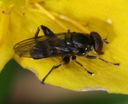
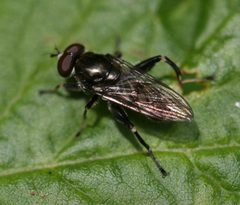
Distinguished from by the combination of all-black coloration (lacking steel blue highlights of C. chalybeus or red abdominal markings of C. piger), enlarged and ventrally spinose hind , and strongly curved hind tibiae. The swollen hind legs are particularly distinctive and visible even in . Males are readily identified by .
Images
Appearance
Wing length 6.5–8.25 mm. Body predominantly black without metallic blue highlights or red abdominal markings. Hind distinctly swollen and deep, with surface bearing closely-set short black hairs for the entire length. Hind tibiae strongly curved. short with tergites 2–4 bearing paired pink or orange-brown marks. Legs black with yellow knees and yellow . (contiguous) in males, separated in females.
Habitat
Forest wetland including Alnus-Salix carr, deciduous forest, and woodland with streams. frequent sunlit foliage of bushes, trunks of fallen trees beside water, and damp mud at water's edge.
Distribution
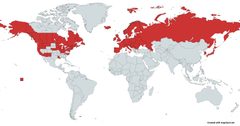
Palearctic: Fennoscandia south to the Pyrenees, Ireland east through Northern, Central and Southern Europe (to South Italy), across Russia and the Russian Far East to Sakhalin and Japan. Nearctic: Alaska to Nova Scotia, south to California.
Seasonality
active from beginning of May to end of September.
Diet
feed on nectar and pollen from flowers including white umbellifers, Caltha, Anemone nemorosa, Euphorbia amygdaloides, Ranunculus, Rubus idaeus, Potentilla erecta, Sorbus aucuparia, and Taraxacum. Larvae are saprophagous, feeding on decaying wood under bark.
Host Associations
- Larix - larval larvae found under bark
- Pinus - larval larvae found under bark
- hardwoods - larval various , larvae found under bark
Life Cycle
Complete . Larvae develop under bark of conifers and hardwoods in decaying wood. occurs in wood. emerge in spring and are active through summer.
Behavior
exhibit hovering typical of syrphid flies. Males possess . Adults frequently settle on sunlit foliage and damp mud at water's edge. Strong association with dead wood ; adults repeatedly return to dead tree trunks when disturbed.
Ecological Role
Larvae contribute to wood decomposition as saprophages in dead and decaying wood. serve as of diverse flowering plants. May function as prey for predatory insects and birds.
Similar Taxa
- Chalcosyrphus chalybeusSimilar size and habitus, but exhibits steely blue coloration absent in C. nemorum; hind leg modifications less pronounced
- Chalcosyrphus pigerSimilar all-black appearance, but consistently shows red abdominal markings absent in C. nemorum
- Xylota spp.Related with similar wood-associated larvae, but lacks the distinctly swollen and spinose hind characteristic of Chalcosyrphus