
Chalcosyrphus metallifer
(Bigot, 1884)
Orange-horned Leafwalker
Chalcosyrphus metallifer, commonly known as the Orange-horned Leafwalker, is a rare of syrphid fly found in the Eastern United States. are typically observed on flowers, where they feed on nectar and pollen. The species belongs to the subgenus Xylotomima within the Chalcosyrphus, a group whose larvae are associated with decaying wood rather than the typical of many hoverflies.
Pronunciation
How to pronounce Chalcosyrphus metallifer: /ˌkælkoʊˈsɪrfəs mɛˈtælɪfər/
These audio files are automatically generated. While they are not always 100% accurate, they are a good starting point.
Identification
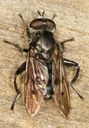
Distinguished from other Chalcosyrphus by its all-black coloration without steel blue highlights (C. chalybeus) or red abdominal markings (C. piger). The enlarged, spinose metafemora and curved tibiae are distinctive morphological features. The subgeneric placement in Xylotomima may provide additional diagnostic characters, though these are not detailed in available sources. As a rare species with limited observations, identification should be confirmed by comparison with or expert consultation.
Images
Appearance
are characterized by enlarged and ventrally spinose metafemora (hind ) with correspondingly curved tibiae, features that are distinctive within the . The exhibits all-black coloration without the steel blue highlights seen in C. chalybeus or the red abdominal markings present in C. piger. Males possess (contiguous) . The "Orange-horned Leafwalker" likely refers to orange coloration on the or other appendages.
Habitat
Associated with forested environments where decaying wood is present, based on the ecological requirements of the . are found on flowers in woodland or forest edge . The larval habitat is decaying wood, distinguishing this from the majority of syrphid flies whose larvae are .
Distribution
Eastern United States; recorded from Canada and United States in GBIF data. Specific state or provincial records are limited due to the ' rarity.
Diet
feed on nectar and pollen from flowers. Larvae are saprophages in decaying wood, not of aphids.
Life Cycle
Larval development occurs in decaying wood; emerge and visit flowers for feeding. Specific details of , larval instars, and developmental timing are not documented.
Behavior
are capable of hovering typical of syrphid flies. Repeatedly returns to and lands on dead wood substrates when disturbed, suggesting strong association with this microhabitat. Adults are commonly found on flowers. The modified hind legs (enlarged, spinose metafemora with curved tibiae) may have a predatory or grasping function, though this remains speculative.
Ecological Role
serve as when visiting flowers for nectar and pollen. Larvae contribute to wood decomposition as saprophages in decaying wood. The represents an unusual ecological guild within Syrphidae, as most members of the have aphidophagous larvae.
Human Relevance
Too rare to have significant economic or ecological impact. Of interest to entomologists studying the diversity of within Syrphidae and the evolution of wood-associated larvae in the . The highlights the importance of dead wood for insect diversity.
Similar Taxa
- Chalcosyrphus chalybeusSimilar all-black coloration but exhibits distinctive steel blue highlights not present in C. metallifer.
- Chalcosyrphus pigerSimilar body form but consistently shows red abdominal markings, which C. metallifer lacks.
- Xylota speciesRelated with similar wood-associated larvae and ; C. metallifer was provisionally considered as possibly belonging to this genus before definitive identification.
Misconceptions
The "hover fly" for syrphids is misleading for this , as the larvae do not hover (they are saprophages in wood) and the is more associated with dead wood substrates than with the sustained hovering typical of many flower-visiting syrphids. Additionally, the larvae are not of aphids, which is the typical for Syrphidae.
More Details
Taxonomic History
Originally described by Bigot in 1884. Placed in subgenus Xylotomima, indicating close relationship to the Xylota. The has been subject to taxonomic uncertainty, with specimens initially identified only to genus level or confused with related .
Conservation Status
Described as rare in the Eastern United States, with only 22 observations recorded in iNaturalist as of the source date. The association with dead wood may make this vulnerable to forest management practices that remove coarse woody debris.
Research Needs
The function of the enlarged, spinose metafemora remains unexplained in the literature. Detailed studies of larval , wood preferences, and are lacking due to the ' rarity.