
Chalcosyrphus metallicus
(Wiedemann, 1830)
Yellow-legged Leafwalker
Chalcosyrphus metallicus is an uncommon of syrphid fly found in the southeastern United States. Unlike many hoverflies that visit flowers for nectar and pollen, of this species are associated with dead and decaying wood. The species exhibits distinctive enlarged and spinose metafemora on the hind legs, a trait shared with related species in the . Larvae develop as saprophages in rotting wood rather than as like many other syrphids.
Pronunciation
How to pronounce Chalcosyrphus metallicus: //ˌkæl.kəˈsɪr.fəs mɪˈtæl.ɪ.kəs//
These audio files are automatically generated. While they are not always 100% accurate, they are a good starting point.
Identification
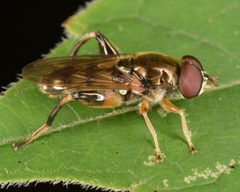
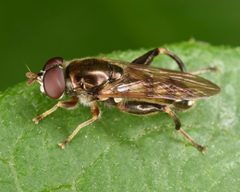
Distinguished from other Chalcosyrphus by its all-black coloration without blue or red markings. The enlarged, toothed metafemora are conspicuous and help separate it from Xylota, which lacks such leg modifications. The combination of black body, robust build, and modified hind legs distinguishes it from typical flower-visiting syrphids. Similar species C. chalybeus shows steely blue highlights, while C. piger has red abdominal markings.
Images
Appearance
are relatively large, hulking, and predominantly black in coloration without the steely blue highlights seen in C. chalybeus or red abdominal markings present in C. piger. The most distinctive feature is the enlarged, ventrally spinose metafemora (hind ) with correspondingly curved tibiae. Males have (contiguous) . The overall robust build and dark coloration contribute to a -like or robber fly-like appearance.
Habitat
Associated with dead and decaying wood, including recently wind-thrown trees and decaying logs. are found on trunks of dead trees, particularly hardwoods such as hickory (Carya). The is linked to forested environments where dead wood is available for larval development.
Distribution
Southeastern United States; specifically recorded from Missouri (Sam A. Baker State Park) and the broader southeastern region. The is described as uncommon throughout its range.
Seasonality
have been observed in summer months (June observations from Missouri). Specific seasonal patterns are poorly documented due to the ' rarity.
Host Associations
- Carya alba (mockernut hickory) - microhabitat observed repeatedly landing on trunk of recently wind-thrown tree
Life Cycle
Larvae develop in decaying wood as saprophages, feeding on decomposing plant material. This represents an exception to the typical -predatory lifestyle of many syrphid larvae. occurs within the wood substrate. timing is poorly documented.
Behavior
exhibit strong fidelity to dead wood substrates, repeatedly returning to and landing on tree trunks when disturbed. This contrasts with flower-visiting habits of most syrphids. Males possess , suggesting visual mate location. The function of the enlarged metafemora remains unclear; they may serve a predatory or grasping function, though adults are not known to be predatory.
Ecological Role
Larvae contribute to wood decomposition as saprophages. may serve as to a limited degree, though their primary ecological role appears tied to dead wood . The represents an unusual ecological guild within Syrphidae, filling a more typical of certain robber flies or other wood-associated insects.
Human Relevance
No documented economic importance. The is of interest to entomologists studying ecological diversification within Syrphidae and dead wood . Its uncommon status makes it a noteworthy find for collectors and naturalists.
Similar Taxa
- Chalcosyrphus chalybeusSimilar all-black appearance but distinguished by steely blue highlights not present in C. metallicus
- Chalcosyrphus pigerSimilar robust build but consistently shows red abdominal markings absent in C. metallicus
- XylotaRelated with similar wood-associated habits, but lacks enlarged, spinose metafemora characteristic of Chalcosyrphus
- Laphriinae (robber flies)Convergent appearance and dead wood association; distinguished by true fly features (single pair of wings, ) and syrphid wing venation
More Details
Taxonomic history
Originally described as Xylota metallica by Wiedemann in 1830, later transferred to Chalcosyrphus. The has been historically overlooked due to its wood-associated habits rather than flower-visiting typical of the .
Leg morphology
The enlarged, ventrally spinose metafemora with curved tibiae are among the most distinctive features of this . While such modifications often indicate predatory function in other insects, their purpose in Chalcosyrphus remains unexplained in published literature. are reported to feed on pollen, not prey.
Rarity
Described as uncommon throughout its range, with few documented observations. This may reflect genuine rarity, cryptic habits on dead wood, or under-sampling of dead wood relative to flower-visiting syrphids.