
Temnostoma alternans
Loew, 1864
Wasp-like Falsehorn
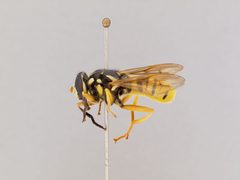
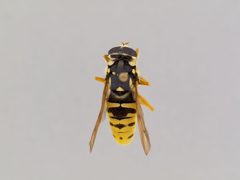
Temnostoma alternans, commonly known as the -like Falsehorn, is a of syrphid fly found throughout northern and central United States and Canada. are flower-visiting hoverflies that obtain nectar and pollen from blossoms. The species exhibits elaborate mimicry of solitary mason wasps, including darkened wing margins that resemble the folded wings of vespid wasps and distinctive leg-waving that mimics wasp . Larvae develop in moist decayed wood.
Pronunciation
How to pronounce Temnostoma alternans: /tɛmˈnɔstɔma ælˈtɜrnænz/
These audio files are automatically generated. While they are not always 100% accurate, they are a good starting point.
Identification
Temnostoma alternans can be distinguished from other syrphid flies by its extreme mimicry: the leading edge of the wings is darkened, simulating the longitudinal folds of vespid wasp wings at rest. When at rest, individuals wave their front pair of legs in front of the , creating the illusion of long wasp . The is likely to be confused with other Temnostoma species, which share this -level mimicry ; precise identification may require examination of specific morphological details.
Images
Habitat
are found in woodland edges and areas with flowering vegetation. Larvae inhabit moist decayed wood, including rotting logs and stumps.
Distribution
Northern and central United States; widespread in Canada. Specific records include Vermont.
Seasonality
have been observed in May; likely active during spring and summer months when flowers are available.
Diet
feed on nectar and pollen from flowers. Larval diet unknown but likely involves decomposing wood material or associated microorganisms.
Host Associations
- Ancistrocerus sp. - mimicry modelSolitary mason wasps in the Vespidae are the likely visual models for Temnostoma mimicry
Life Cycle
Complete with larval stage in moist decayed wood. Specific details of , pupal, and larval development stages are not documented.
Behavior
exhibit hovering typical of syrphid flies and can remain nearly motionless in air. The performs distinctive leg-waving : when at rest, the front pair of legs is waved in front of the to simulate . Adults are commonly found on flowers.
Ecological Role
may contribute to pollination through flower visitation. Larvae likely contribute to wood decomposition processes in forest .
Similar Taxa
- Sphecomyia vittataBoth are syrphid flies with extreme mimicry, but Sphecomyia vittata possesses unusually long, thick for a fly and mimics yellowjackets in rather than mason wasps
- Somula decoraAnother syrphid mimic, but larger (-sized), heavily marked with golden yellow, and likely mimics scoliid wasps or yellowjackets rather than mason wasps
- Chalcosyrphus speciesRelated syrphid flies with wood-inhabiting larvae and mimicry, but typically mimic spider wasps (Pompilidae) or other solitary wasps and may flick wings while running on surfaces
More Details
Mimicry specialization
Temnostoma represent one of the most specialized cases of mimicry in Diptera, extending to behavioral modifications (leg-waving) and wing (darkened costal margins) that precisely match vespid wasp characteristics