
Spilomyia sayi
(Goot, 1964)
Four-lined Hornet Fly
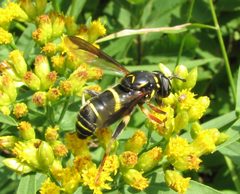
Spilomyia sayi is a common North American hoverfly and mimic, ranging from western Canada to the northeastern United States. are active from June to October and are frequently found on flowers where they feed on nectar and pollen. The exhibits remarkable mimicry of yellowjacket wasps, including visual, behavioral, and acoustic deception. Larvae develop in decaying heartwood of deciduous trees and in rot holes.
Pronunciation
How to pronounce Spilomyia sayi: /ˌspaɪloʊˈmaɪə ˈseɪaɪ/
These audio files are automatically generated. While they are not always 100% accurate, they are a good starting point.
Identification
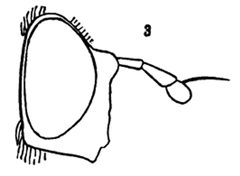
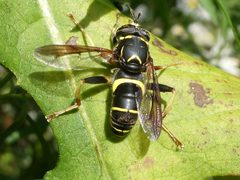
measure 10–16 mm. The black bears a prominent inverted V-shaped yellow mark above the margin, with additional yellow spots on the humeri and a slender line above the wings. The scutellum is black with a narrow yellow rim. The pleurae display distinct yellow markings: a large elongate spot on the mesopleuron, a rounded spot on the sternopleuron, and a smaller spot above the front . The elongate cylindrical is scarcely wider than the and bears four yellow bands: segment 2 has a strongly arcuate band continuing onto segment 3; segment 3 has a band narrowly interrupted in the middle; segment 4 has both a median interrupted band and a posterior band. The is yellow with a wide median black stripe and nearly straight profile. are elongate, with the pedicle nearly twice as long as the scape. Male are and bare, with a brown color pattern. Front and mid are strongly swollen. Hind femur has an anteriolateral spur. Wings are elongate with brownish coloration along the front border, hyaline behind; R4+5 is acute and slightly , cell r1 is open, and crossvein r-m is strongly oblique.
Images
Habitat
frequent flowers in various . Larvae inhabit moist areas including rot holes of trees and decaying heartwood of deciduous trees.
Distribution
Western Canada to northeastern North America; recorded in Canada and the United States, including Vermont.
Seasonality
active from June to October in the northern part of the range.
Diet
feed on nectar and pollen from flowers. Larval diet consists of decaying organic matter in tree holes and rotting wood.
Life Cycle
Larvae are known as short-tailed larvae, adapted for moist environments. Development occurs in water-filled tree holes and decaying heartwood. Specific details of and timing are not documented.
Behavior
Males engage in , perching on high ground to await females. are capable of hovering nearly motionless in . The exhibits sophisticated mimicry: in addition to yellow and black coloration, individuals wave their front legs to simulate the longer of yellowjackets, and the wingbeat frequency matches that of wasp models. The portion of each wing is darkened to mimic the longitudinally folded wings of resting vespid wasps.
Ecological Role
serve as when visiting flowers. Larvae function as decomposers and nutrient cyclers in decaying wood. The contributes to indirectly through its larval preferences.
Human Relevance
are beneficial in gardens and natural areas. The is frequently encountered by naturalists and photographers due to its conspicuous -like appearance. No negative impacts on human activities are documented.
Similar Taxa
- Spilomyia longicornisAnother North American Spilomyia with similar -mimic appearance; distinguished by antennal and abdominal pattern differences
- yellowjackets (Vespula and Dolichovespula species)Visual and acoustic mimicry is so effective that close inspection is required; flies have single pair of wings, short with , and large in males
Sources and further reading
- BugGuide
- Wikipedia
- GBIF taxonomy match
- iNaturalist taxon
- NCBI Taxonomy
- Catalogue of Life
- From Caterpillars to Butterflies to Chronic Pain Research | Bug Squad
- Bruce Hammock: From ResearchIng Insect Science to Researching Autism and Schizophrenia | Bug Squad
- Bug Eric: Stop Saying the Monarch is a "Gateway Species" for an Appreciation of Other Insects
- Bug Eric: July 2011
- Hover Flies Identified: Researchers Tackle 20,000 Syrphid Specimens in Illinois Collection
- Bug Eric: Spider Sunday: Funnel-web Wolf Spiders