
Myathropa
Rondani, 1845
Species Guides
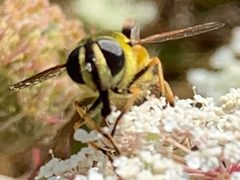
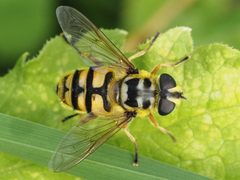
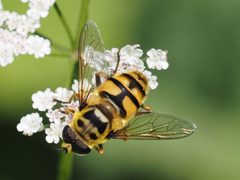
1- Myathropa florea(Batman hoverfly)
Myathropa is a of hoverflies ( Syrphidae) distributed across Europe, North Africa, and extending into parts of Asia. are active from May to September and are frequently observed visiting flowers. The genus includes at least three described : M. florea, M. semenovi, and M. usta. Some species exhibit of social .
Pronunciation
How to pronounce Myathropa: /ˌmaɪəˈθroʊpə/
These audio files are automatically generated. While they are not always 100% accurate, they are a good starting point.
Identification
within Myathropa may be distinguished by subtle morphological differences in thoracic and abdominal patterning. M. florea is the most widespread and commonly encountered species in Europe. For precise identification, examination of genitalic structures and comparison with is recommended.
Images
Habitat
occur in diverse environments where flowering plants are present. Larvae develop in organic, waterlogged detritus, particularly in shallow rot holes of tree stumps where bacterial proliferate.
Distribution
Europe, North Africa, and parts of Asia including India (first records of the from India documented for M. semenovi in the Kashmir Himalayas). GBIF records confirm presence in Denmark, Norway, and Sweden.
Seasonality
activity recorded from May to September.
Diet
Larvae feed on bacteria in organic waterlogged detritus. feeding habits on flowers are presumed but not explicitly documented in available sources.
Life Cycle
Larval development occurs in waterlogged organic matter, specifically rot holes in tree stumps. Complete details including deposition site, location, and developmental duration are not documented in available sources.
Behavior
Ecological Role
Larvae contribute to decomposition processes in waterlogged woody detritus. likely serve as during flower visitation.
Similar Taxa
- HelophilusBoth are in tribe Eristalini and share similar larval in organic waterlogged matter; may be confused due to shared yellow-and-black coloration patterns.
- SericomyiaBoth are mimetic syrphid with -like appearance; studied alongside Myathropa in comparative research, though Sericomyia generally shows different flight patterns.
- SyrphusBoth are mimetic hoverflies, but Syrphus is a non-specific mimic with markedly different foraging (slower, more hesitant, roundabout routes) compared to Myathropa.
More Details
Mimicry and Flight Behavior
Research on M. florea indicates that behavioral mimicry of does not strictly correlate with morphological resemblance. Unlike Syrphus sp., which shows similar to Vespula vulgaris, M. florea maintains faster, more direct flight during foraging despite being a morphological mimic.
Taxonomic Notes
The was first documented in India in 2024 with the discovery of M. semenovi in the Kashmir Himalayas, representing a significant range extension for the genus.
Sources and further reading
- BugGuide
- Wikipedia
- GBIF taxonomy match
- iNaturalist taxon
- NCBI Taxonomy
- Catalogue of Life
- First records of the genus Myathropa Rondani, 1845 (Diptera, Syrphidae) from India with new distributional and taxonomic notes for Myathropa semenovi (Smirnov, 1925)
- Flight behaviour during foraging of the social waspVespula vulgaris(Hymenoptera: Vespidae) and four mimetic hoverflies (Diptera:Syrphidae)Sericomyia silentis,Myathropa florea,Helophilussp. andSyrphussp.