
Myathropa florea
(Linnaeus, 1758)
Batman hoverfly, Yellow-haired Sun Fly
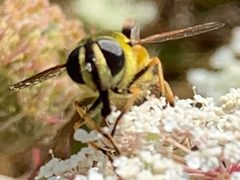
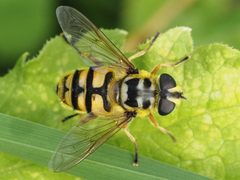
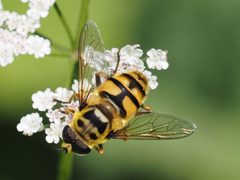
Myathropa florea is a common Palearctic hoverfly in the tribe Eristalini, often called the Batman hoverfly due to the distinctive skull-like pattern on its . are active flower visitors from May to October and are notable for their -mimicking appearance. The has become in western North America since 2005. Larvae develop in waterlogged organic detritus, particularly in tree rot holes.
Pronunciation
How to pronounce Myathropa florea: /maɪˈæθrəpə ˈflɔːriə/
These audio files are automatically generated. While they are not always 100% accurate, they are a good starting point.
Identification
The skull-shaped thoracic pattern is diagnostic and distinguishes Myathropa florea from similar Eristalini hoverflies such as Eristalis tenax (drone fly), which lacks this pattern and is generally duller in coloration. From Helophilus , which also have yellow and black thoracic markings, M. florea differs in the specific configuration of the dark central smudge interrupting the pale bands. Syrphus species are smaller and lack the bold thoracic pattern.
Images
Habitat
Deciduous forests, fen carr, farmland with trees, parks, and gardens. Larval consists of waterlogged organic detritus, often in shallow rot holes of tree stumps.
Distribution
Native to the Palearctic region: Fennoscandia south to Iberia and the Mediterranean basin, Ireland eastwards across Europe and Russia, and North Africa. on the Pacific coast of North America since 2005.
Seasonality
active from May to October, with peak activity May to September.
Diet
visit diverse flower for nectar and pollen, including umbellifers, Castanea, Convolvulus, Crataegus, Chaerophyllum, Euonymus, Filipendula, Hedera, Rhododendron, Rubus, Sambucus, Solidago, Sorbus, and Viburnum opulus. Larvae feed on bacteria in organic waterlogged detritus.
Life Cycle
Larvae develop in waterlogged organic detritus, particularly in shallow rot holes of tree stumps. Larval was described by Graham E. Rotheray in 1993.
Behavior
Foraging has been studied in comparison to social ; unlike the non-specific mimic Syrphus, M. florea does not closely match wasp flight patterns, flying more directly with less hesitation before landing. This suggests that morphological and behavioral mimicry can evolve independently in hoverflies.
Ecological Role
contribute to pollination of diverse flowering plants. Larvae participate in decomposition of organic matter in aquatic or semi-aquatic environments.
Human Relevance
in North America may serve as in introduced range. No significant pest or beneficial status documented.
Similar Taxa
- Eristalis tenaxSimilar size and general appearance, but lacks distinctive skull-patterned and is generally duller brown rather than bright yellow
- Helophilus spp.Share yellow and black thoracic markings, but have different pattern configuration without the central black smudge interrupting pale bands
- Syrphus spp.Smaller, more slender, and lack the bold thoracic skull pattern; show closer behavioral mimicry of in
More Details
Color preservation
Yellow pigmentation in living specimens fades rapidly to brown after death, making museum specimens appear much duller than live individuals.
Mimicry research
Studies of indicate that morphological resemblance to does not necessarily correlate with behavioral mimicry in this .
Invasion history
First recorded on the Pacific coast of North America in 2005; establishment and spread in this range ongoing.
Sources and further reading
- BugGuide
- Wikipedia
- GBIF taxonomy match
- iNaturalist taxon
- NCBI Taxonomy
- A Buggy New Year! | Bug Squad
- Zeroing in on the Deadly Game Between Honey Bees and Their Predators | Bug Squad
- Walking Among Giants in Northwest Thailand
- Insecticidal Nesting Materials May Help Birds on the Galápagos Islands
- Flight behaviour during foraging of the social waspVespula vulgaris(Hymenoptera: Vespidae) and four mimetic hoverflies (Diptera:Syrphidae)Sericomyia silentis,Myathropa florea,Helophilussp. andSyrphussp.