
Orthonevra
Macquart, 1829
Mucksuckers
Species Guides
6- Orthonevra bellula(Three-lined Mucksucker)
- Orthonevra feei(Fee's Mucksucker)
- Orthonevra flukei(Fluke's Mucksucker)
- Orthonevra nitida(Wavy Mucksucker)
- Orthonevra pictipennis(Dusky-veined Mucksucker)
- Orthonevra pulchella(Dusky Mucksucker)
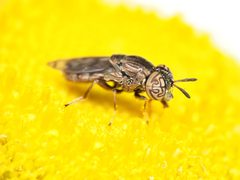
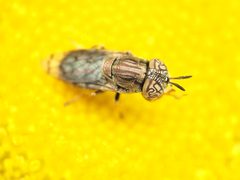
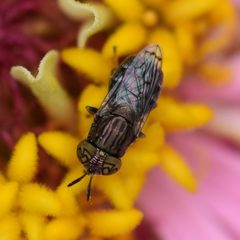
Orthonevra is a of hoverflies (Syrphidae) in the tribe Brachyopini, with at least 59 distributed worldwide. The genus is commonly known as "mucksuckers" due to larvae that inhabit organic-rich mud. Species are concentrated in eastern North America and Europe, with additional diversity in the Neotropics where 20 species occur. are small, often metallic-looking flies with distinctive morphological features including stripes and elongate .
Pronunciation
How to pronounce Orthonevra: /ɔɹθəˈnɛvɹə/
These audio files are automatically generated. While they are not always 100% accurate, they are a good starting point.
Identification
Distinguished from other Brachyopini (Melanogaster, Brachyopa, Neoascia, Sphegina) by combination of: black with blue-purple reflections, elongate with rounded orange third segment, wrinkled with silvery spots, and wing M1 curving away from wing tip. Males of closely related distinguished by structures of the terminalia. may be mistaken for Chrysogaster hoverflies; O. brevicornis distinguished from other Orthonevra by rounded third antennal segment.
Images
Habitat
Larvae inhabit organic-rich mud (muck). associated with damp including marshes, fens, and damp forests. One (O. nitida) observed visiting flowers of Daisy Fleabane in back yard environments.
Distribution
Worldwide distribution with at least 59 . Concentrated in eastern North America and Europe. European species include O. brevicornis (Central Europe to Transcaucasia), O. atlantica (Atlantic Europe), O. incisa (Poland), O. montana (Poland, Austria, Germany), O. gemmula (Hungary). O. frontalis removed from Polish fauna. Neotropical region holds 20 species. O. brevicornis in England and Wales with rare Scottish records. GBIF records from Denmark, Norway, Sweden, Vermont-US, and US generally.
Seasonality
period for O. brevicornis runs from May to September with numbers peaking in June. O. nitida observed in August.
Life Cycle
Larvae are aquatic, inhabiting organic-rich mud. with in spring through summer.
Similar Taxa
- Chrysogaster superficially similar; O. brevicornis males can be mistaken for Chrysogaster hoverflies and may be overlooked due to shared damp
- MelanogasterShared tribe Brachyopini; distinguished by Orthonevra's elongate and distinctive structure
- BrachyopaShared tribe Brachyopini; distinguished by Orthonevra's metallic reflections and stripes
- NeoasciaShared tribe Brachyopini; distinguished by Orthonevra's wrinkled with silvery spots
- SpheginaShared tribe Brachyopini; distinguished by Orthonevra's rounded third antennal segment and wing venation
More Details
Taxonomic History
revised multiple times; recent work (2024) split O. brevicornis into two , describing O. atlantica sp. nov. Neotropical fauna revised with 12 new species described. C. lugubris removed from Orthonevra and left incertae sedis.
Genomic Resources
Reference generated for O. brevicornis as part of Darwin Tree of Life project. Genome assembly contains two haplotypes (788.61 Mb and 718.58 Mb), with haplotype 1 scaffolded into 6 chromosomal pseudomolecules including X . has X0 karyotype in males.
Identification Resources
Comprehensive keys available: van Veen (2004) for European ; Seman (1964) for North American species; M.C.D. Speight documentation for European species; interactive pictorial key for Neotropical species.
Sources and further reading
- BugGuide
- Wikipedia
- GBIF taxonomy match
- iNaturalist taxon
- NCBI Taxonomy
- Catalogue of Life
- Bug Eric: Home Bioblitz, Ongoing
- Bug Eric: 2021
- The Neotropical Orthonevra Macquart, 1829 (Diptera: Syrphidae)
- Two Palaearctic species of Orthonevra (Diptera: Syrphidae) under the name O. brevicornis
- The genome sequence of the hoverfly, Orthonevra brevicornis (Loew, 1843) (Diptera: Syrphidae).