
Psellidotus hieroglyphicus
(Olivier, 1811)
soldier fly
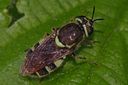
Psellidotus hieroglyphicus is a of soldier fly in the Stratiomyidae. It is one of numerous species in the Psellidotus, which belongs to the Stratiomyinae. The species was described by Olivier in 1811. Like other members of its subfamily, the larvae are aquatic. are characterized by patterned with horizontal banding, a trait shared with many stratiomyine flies and thought to be associated with detection of horizontally polarized light for locating water sources.
Pronunciation
How to pronounce Psellidotus hieroglyphicus: /pˌsɛlɪˈdoʊtəs haɪˌɛrəˈɡlɪfɪkəs/
These audio files are automatically generated. While they are not always 100% accurate, they are a good starting point.
Identification
Members of the Psellidotus are similar to the genus Odontomyia, with which they share the tribe Stratiomyini. In the Nearctic region, Psellidotus and the related genus Hedriodiscus are readily separable, though this distinction becomes less clear in the Neotropics. typically exhibit patterned with horizontal banding. Positive identification to level requires examination of detailed morphological characters and comparison with or authoritative descriptions.
Images
Distribution
United States. The has been documented in North America, though specific state-level records are limited in available sources.
Life Cycle
Larvae of the Stratiomyinae are aquatic, developing in water or moist substrates. The specific larval and developmental details for P. hieroglyphicus have not been documented in available sources.
Ecological Role
As a member of the aquatic Stratiomyinae, larvae likely contribute to nutrient cycling in freshwater or moist . may serve as when visiting flowers.
Similar Taxa
- OdontomyiaBoth belong to tribe Stratiomyini and share similar overall . Psellidotus can be distinguished by subtle morphological differences, though the distinction is clearer in the Nearctic than in the Neotropics.
- HedriodiscusRelated in the same tribe; easily separable from Psellidotus in the Nearctic region but distinction becomes fuzzy in the Neotropics.
More Details
Eye patterning and polarized light vision
Like many stratiomyine flies, Psellidotus hieroglyphicus exhibits horizontal banding patterns on the . This patterning is thought to be associated with the ability to detect horizontally polarized light, a trait common in aquatic insects for locating water surfaces, mates, and oviposition sites.
Taxonomic history
The was first described by Olivier in 1811. The Psellidotus contains numerous species, many of which are poorly known outside of their original descriptions, particularly in the Neotropics.