
Hedriodiscus
Enderlein, 1914
Species Guides
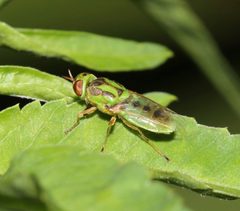
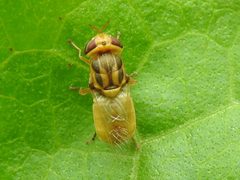
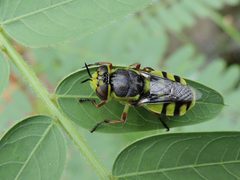
6Hedriodiscus is a of soldier flies in the Stratiomyidae, Stratiomyinae, and tribe Stratiomyini. The genus comprises approximately 26 described distributed primarily in the Nearctic and Neotropical regions. Larvae of at least some species, such as H. truquii, are aquatic and associated with thermal spring , where they function as herbivores feeding on . are characterized by patterned with horizontal banding, a trait shared with related genera in the tribe and potentially linked to detection of horizontally polarized light for locating aquatic oviposition sites.
Pronunciation
How to pronounce Hedriodiscus: /hɛd.ri.oʊˈdɪs.kəs/
These audio files are automatically generated. While they are not always 100% accurate, they are a good starting point.
Identification
Hedriodiscus is similar to the Psellidotus, with which it shares membership in the tribe Stratiomyini. In the Nearctic region, these two genera are readily separable, though the distinction becomes less clear in the Neotropics, particularly in South America. possess horizontally banded patterns that may aid in recognition and location. Species-level identification requires examination of specific morphological characters not detailed in available sources.
Images
Habitat
Aquatic and semi-aquatic environments, including thermal springs. Larvae of H. truquii inhabit thermal spring with water temperatures ranging from approximately 35°C to 47°C.
Distribution
Nearctic and Neotropical regions. Distribution records include Colombia. occur from North America through Central and South America, with multiple species described from Argentina and other South American localities.
Diet
Larvae are herbivorous, feeding on . H. truquii is described as the herbivore in thermal spring , consuming algal .
Life Cycle
Development includes four larval instars. Larvae are aquatic. occurs in soil. Newly emerged are subject to by spiders. Larval lipid composition varies seasonally during growth.
Behavior
Larvae exhibit diel patterns that vary between , potentially affecting energy allocation and growth. Export of larvae from thermal spring systems and spider on newly emerged represent significant sources of mortality and .
Ecological Role
H. truquii functions as a herbivore in thermal spring , channeling 0.5–1.0% of algal through its . The contributes to energy flow and nutrient cycling in these thermally-influenced . Spider on emerging provides a food source for terrestrial .
Similar Taxa
- PsellidotusBoth belong to the tribe Stratiomyini and share similar . They are easily separable in the Nearctic region but distinction becomes fuzzy in the Neotropics, especially South America.