
Hedriodiscus truquii
(Bellardi, 1859)
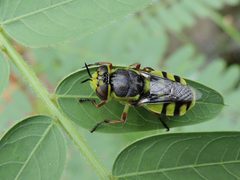
Hedriodiscus truquii is a soldier fly ( Stratiomyidae) whose larval has been studied in thermal spring . The was described by Bellardi in 1859 and occurs in North and Central America. A detailed 4-year ecological study documented its role as a herbivore in two thermal spring in Washington State, where larvae feed on and serve as a significant energy conduit in these extreme . Larvae are aquatic and subject to heavy pressure, particularly from spiders on newly emerged .
Pronunciation
How to pronounce Hedriodiscus truquii: //ˌhɛdri.oʊˈdɪskəs ˈtruːki.aɪ//
These audio files are automatically generated. While they are not always 100% accurate, they are a good starting point.
Identification
Hedriodiscus truquii belongs to the tribe Stratiomyini, which includes the similar Psellidotus. These two genera are readily separable in the Nearctic region but distinctions become less clear in the Neotropics. likely exhibit the horizontally banded patterns characteristic of many Stratiomyinae, possibly indicating polarization vision capabilities. Specific diagnostic features for distinguishing H. truquii from are not documented in available sources.
Images
Habitat
Thermal spring with aquatic conditions. Documented from two springs in Washington State with mean temperatures of 35°C and 47°C respectively. Larvae are aquatic, inhabiting the algal mats and submerged vegetation of these heated, mineral-rich waters. The has been observed in springs with differing floral and faunal compositions, suggesting adaptability to varying thermal and biological conditions within the thermal spring .
Distribution
United States (Washington State—documented from Mount Rainier National Park; also recorded from other states), Mexico, and El Salvador. Distribution records suggest a range spanning temperate and subtropical regions of North and Central America.
Diet
Larvae are herbivores, feeding on . In the studied thermal springs, only 0.5–1.0% of algal was channeled to Hedriodiscus , indicating that while abundant, the processes a relatively small fraction of available algal . diet is not documented.
Life Cycle
Four larval instars documented. Larval growth shows seasonal variation in lipid composition, which correlates with observed caloric variation. Energy budgets have been calculated for three of the four instars based on growth, respiration, and food ingestion rates. occurs in the soil or substrate of the aquatic . Heavy mortality occurs at the stage due to .
Behavior
Larvae exhibit diel patterns that vary between , affecting energy allocation and metabolic . Newly emerged are vulnerable to , particularly by spiders. Larvae are subject to export from the system, representing a significant source of population mortality and energy loss from the .
Ecological Role
herbivore and principal macroinvertebrate consumer in thermal spring studied. Serves as a critical conduit for energy transfer from primary producers () to higher , particularly . energy budgets indicate substantial role in energetics despite processing a small percentage of total algal production. Represents a significant prey resource for spiders and other predators. Larval export contributes to energy loss from the spring system.
Similar Taxa
- PsellidotusClosely related within tribe Stratiomyini; morphologically similar and easily confused, especially in the Neotropics where generic boundaries become less distinct. Both genera share aquatic larval habits and patterning.
More Details
Thermal Physiology
in springs with different temperature regimes (35°C vs. 47°C means) show variation in energy allocation and metabolic , attributed to behavioral and physiological adaptations to thermal conditions.
Population Regulation
Export of larvae from the system and spider on newly emerged represent the most significant sources of mortality, rather than resource limitation or .
Energy Budget
Comprehensive energy budgets have been constructed for this , including estimates of growth, respiration, ingestion rates, and -level energetics—unusual detail for a dipteran of this .