
Sarginae
Walker, 1834
soldier flies
Genus Guides
6- Cephalochrysa(soldier flies)
- Chloromyia
- Merosargus(soldier flies)
- Microchrysa(soldierfly)
- Ptecticus(soldier flies)
- Sargus
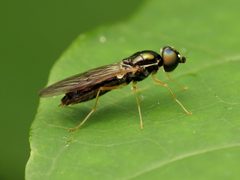
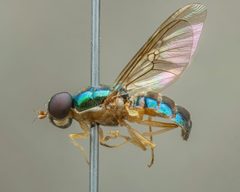
Sarginae is a of soldier flies (Diptera: Stratiomyidae) established by Walker in 1834. The subfamily is in distribution, occurring from the Nearctic region through Canada and Alaska to the Neotropics, with substantial diversity in such as Acrochaeta, Himantigera, Merosargus, and Sargus. stages are known for relatively few —29 species as of 2022, with only eight from the Neotropical region.
Pronunciation
How to pronounce Sarginae: /ˈsɑrɡɪniː/
These audio files are automatically generated. While they are not always 100% accurate, they are a good starting point.
Identification
of Sarginae can be distinguished from other Stratiomyidae using the keys provided in McFadden (1972) for the Nearctic region. Within the subfamily, are distinguished by characters of the , , and male and female terminalia. For example, Acrochaeta is characterized by features of the head, thorax and that support its monophyly, with an inner clade (A. flaveola group) distinguished by terminalia characters.
Images
Habitat
Larvae develop in association with plant materials, including rotting vegetal material. In the Neotropics, Merosargus larvae have been reared from 21 resource types across 15 plant including herbs, vines, palms, and trees. are often found near larval development sites, with males defending oviposition sites.
Distribution
. Documented from Canada and Alaska through the Neotropical region including Brazil, Bolivia, Peru, Rica, Panama, Colombia, Mexico, Nicaragua, Venezuela, Trinidad and Tobago, and Ecuador. Specific new records include Merosargus cingulatus from Ceará, Maranhão, Mato Grosso do Sul, and Rio de Janeiro states in Brazil.
Diet
Larvae feed on plant resources and decaying vegetal material. The degree of specialization varies: six of twelve Merosargus studied in Brazil were reared from only one resource type, with each resource type used on average by less than two species, indicating high larval resource specialization.
Life Cycle
Development includes , larval (with multiple instars), puparial, and stages. of Neotropical such as Merosargus cingulatus and Ptecticus lanei have been described and illustrated. stages remain unknown for the majority of species—only 29 of approximately 142+ described species in Merosargus alone have documented immatures.
Behavior
males of Merosargus defend oviposition sites, exhibiting territorial that may lead to . This territoriality may drive resource specialization and partitioning among sympatric .
Ecological Role
Larvae contribute to decomposition of plant material. High larval resource specialization and small overlap in resource use among sympatric Merosargus may facilitate local coexistence and explain high diversity.
Similar Taxa
- BeridinaeTreated alongside Sarginae in McFadden (1972); distinguished by and larval morphological characters in provided keys.
- ClitellariinaeTreated alongside Sarginae in McFadden (1972); distinguished by and larval morphological characters in provided keys.
More Details
Taxonomic instability
Generic limits within Sarginae remain problematic. Phylogenetic analysis indicates Merosargus is with Acrochaeta as a subclade, requiring broader study for resolution. Multiple transfers have occurred between Acrochaeta, Merosargus, Chrysochlorina, Sargus, Microchrysa, and Himantigera in recent revisions.
Research gaps
stages are poorly known across the . Despite comprising one of the largest with 142 described , Merosargus has documented immatures for only 29 species. Biological data on , diet, and remain sparse for most genera.
Sources and further reading
- BugGuide
- Wikipedia
- iNaturalist taxon
- NCBI Taxonomy
- Catalogue of Life
- Use of Plant Resources byMerosargus(Diptera, Stratiomyidae, Sarginae) Larvae
- THE SOLDIER FLIES OF CANADA AND ALASKA (DIPTERA: STRATIOMYIDAE): I. BERIDINAE, SARGINAE, AND CLITELLARIINAE
- Taxonomic revision and cladistic analysis of the Neotropical genus Acrochaeta Wiedemann, 1830 (Diptera: Stratiomyidae: Sarginae)
- Taxonomic revision of the Neotropical genus Himantigera James, 1982 (Diptera: Stratiomyidae: Sarginae), including the description of two new species and a key to the known species
- Puparium of Merosargus cingulatus Schiner, 1868 and Ptecticus lanei James, 1941 (Diptera: Stratiomyidae: Sarginae), with new geographical records for the species and a list of all known immatures of the subfamily