
Chloromyia
Duncan, 1837
Species Guides
1- Chloromyia formosa(Broad Centurion)
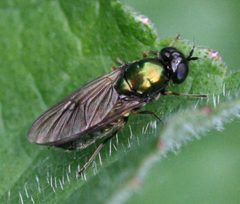
Chloromyia is a of soldier flies in the Stratiomyidae, Sarginae. The genus contains seven described , with Chloromyia formosa (Broad Centurion) being the most extensively studied and the only representative in Britain. Members are medium-sized flies with metallic coloration and distinctive in structure. The genus has a primarily Palaearctic distribution, with some species introduced to North America.
Pronunciation
How to pronounce Chloromyia: //klɔːˈroʊmiə//
These audio files are automatically generated. While they are not always 100% accurate, they are a good starting point.
Identification
Males of Chloromyia formosa have (contiguous) that are densely hairy, a key diagnostic feature. Metallic green and golden-brown in males; females have bluish abdomen. Body length 7–9 mm. Larvae have 7–9 longitudinal stripes with one central dark stripe. The can be distinguished from related stratiomyid genera by combination of metallic coloration, male holoptic eyes, and larval striping pattern.
Images
Habitat
occur in damp areas with fertile soil, including grassland and woodland edges. Larvae develop in moist organic substrates: rotting vegetation, compost, cow , and grass tussocks.
Distribution
Palaearctic distribution: widespread in Europe and North Africa. Chloromyia formosa is very common and widely dispersed throughout Britain, less frequent in northern Scotland; introduced and established in the United States. Distribution records from Denmark, Norway, and Sweden indicate broader Scandinavian presence.
Seasonality
on wing from early May to end of August, occasionally extending to early October, with peak activity in early July.
Diet
feed on flowers, particularly umbellifers such as hogweed.
Life Cycle
Larval development occurs in rotting vegetation, compost, or cow . Specific details on stage, , and time are not documented.
Behavior
Males occasionally observed hovering above ground. Swarming has been noted.
Human Relevance
Chloromyia formosa has been sequenced (790.81 Mb, 98.79% scaffolded into 7 chromosomal pseudomolecules). The serves as a model for soldier fly and .
Similar Taxa
- Other Stratiomyidae generaChloromyia is distinguished by the combination of metallic coloration, male densely hairy , and specific larval in rotting organic matter; other may share metallic coloration but differ in eye structure or larval .
More Details
Genomic resources
Chloromyia formosa : 790.81 Mb total size, 98.79% scaffolded into 7 chromosomal pseudomolecules (6 + X ), mitochondrial genome 17.69 kb.
Species diversity
Seven recognized: C. bella, C. caeligera, C. cingulata, C. coerulea, C. formosa, C. speciosa, and C. tuberculata.