
Chloromyia formosa
(Scopoli, 1763)
Broad Centurion, Broad Centurion Fly
Chloromyia formosa is a medium-sized soldier fly in the Stratiomyidae, measuring 7–9 mm in length with distinctive metallic coloration. It is the only of Chloromyia occurring in Britain and is widely distributed across Europe, North Africa, and the Near East, with introduced in the United States. The species exhibits pronounced in abdominal coloration and structure. are active from spring through summer, with larvae developing in decaying organic matter.
Pronunciation
How to pronounce Chloromyia formosa: //klɔːˈrɒmiːə fɔːrˈmoʊsə//
These audio files are automatically generated. While they are not always 100% accurate, they are a good starting point.
Identification
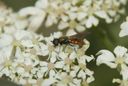
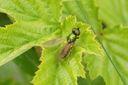
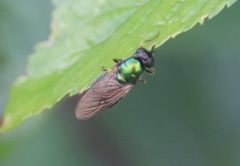
Distinguished from other soldier flies by combination of metallic green , broad flattened with sexually dimorphic coloration (blue-green in females, -green in males), and yellowish-brown wings. Males readily identified by (contiguous) . The only Chloromyia in Britain, reducing identification complexity in that region. Separated from similar Stratiomyidae by the short with elongated first segment and black legs with yellow knees.
Images
Habitat
Wooded areas, hedgerows, moist forests, wet meadows, parks, and gardens. Requires damp with fertile soil. frequent flowers, particularly umbellifers.
Distribution
Native to Europe (widespread including Austria, Belgium, Bulgaria, Czech Republic, Denmark, Finland, France, Germany, Greece, Ireland, Italy, Luxembourg, Netherlands, Norway, Poland, Russia, Spain, Sweden, Switzerland, United Kingdom), Near East, North Africa, and . Introduced and established in the United States. Common and widely dispersed in Britain, becoming less frequent in northern Scotland.
Seasonality
active from April through August, with peak activity in early July.
Diet
feed on nectar and pollen, primarily from flowers of Apiaceae (umbellifers) including hogweed, and pollen of Filipendula ulmaria (Rosaceae).
Life Cycle
Larvae develop in humus-rich soil, rotting vegetation, compost, or cow , feeding on dead leaves and decaying plant matter. Larvae have 7–9 longitudinal stripes with one central dark stripe. Larvae overwinter after reaching final instar. Multiple mating events occur between April and August.
Behavior
frequently visit flowers for feeding. Males occasionally hover above ground. Swarming has been observed. Adults are alert and capable of when disturbed.
Ecological Role
function as of flowering plants. Larvae contribute to decomposition of organic matter in soil and compost .
Human Relevance
Used as a model organism for genomic studies; sequenced in 2024. No significant pest or beneficial economic status documented. Occasionally observed in gardens and parks.
Similar Taxa
- Other StratiomyidaeChloromyia formosa distinguished by metallic green combined with broad, flattened and specific leg coloration (black with yellow knees); many soldier flies lack this combination or have different body proportions.
More Details
Genomic Resources
sequenced and published in 2024 (Wellcome Open Research), providing molecular resources for studying this .
Nomenclature
Also known as 'Broad centurion' in some sources; refers to the broad, flattened abdominal shape.
Sources and further reading
- BugGuide
- Wikipedia
- GBIF taxonomy match
- iNaturalist taxon
- NCBI Taxonomy
- Catalogue of Life
- Cicindela formosa pigmentosignata (the “reddish-green sand tiger beetle”) | Beetles In The Bush
- Cicindela lengi vs. Cicindela formosa | Beetles In The Bush
- A Termite-Control Twofer: How Baiting One Colony of Formosan Subterranean Termites Can Knock Out the Colony Next Door
- The genome sequence of the Broad Centurion soldierfly, Chloromyia formosa (Scopoli, 1763).