
Ptecticus
Loew, 1855
soldier flies
Species Guides
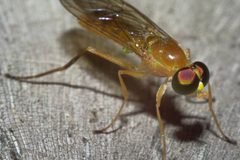
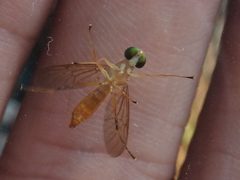
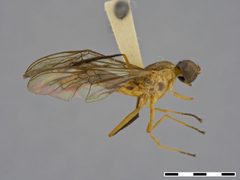
3Ptecticus is a large of soldier flies (Stratiomyidae: Sarginae) comprising at least 150 described worldwide, with roughly 40 species documented from the Old World alone as of 2000. display variable body coloration—yellow, brown, or black—with abdominal transverse stripes, dusky wings, and often translucent second abdominal segments. A well-developed inner projection on the second antennal segment characterizes most species. The genus exhibits -mimicry in appearance and . Larvae are broad, flat, segmented maggots found in fermenting fruit and rotting vegetal material.
Pronunciation
How to pronounce Ptecticus: /ˈptɛktɪkəs/
These audio files are automatically generated. While they are not always 100% accurate, they are a good starting point.
Identification
distinguished from other Stratiomyidae by the well-developed inner projection of the second antennal segment present in most . often bears transverse stripes and may show translucent second segment; wings frequently dusky. Body ground color ranges from yellow through brown to black. Oriental species assigned to eight species groups (aurifer, australis, cingulatus, histrio, longipennis, shirakii, japonicus, tricolor) plus five unplaced species.
Images
Habitat
Larval include fermenting fruit, rotting vegetal material, and decomposing organic substrates. associated with fallen fruit in forest environments.
Distribution
distribution spanning Old World (40+ ), Oriental Region (eight species groups defined), Australasia, China (19 documented species), Neotropical Region including Amazon rainforest (Brazil), and North America (Vermont, USA). New distributional records continue to emerge for Brazil (Ceará, Maranhão, Mato Grosso do Sul, Rio de Janeiro, Paraná).
Host Associations
- Casearia combaymensis - larval substratefallen fruit in Amazon rainforest, of P. testaceus
- Mangifera indica - associated with fruitP. testaceus associated with mango in Rica
Life Cycle
Complete with , larval, pupal, and stages. Larvae are broad, flat, segmented maggots. described for some (e.g., P. lanei). stages documented for relatively few species; as of recent work, 29 Sarginae species have known immatures, with only eight from the Neotropical Region.
Behavior
exhibit -mimicry in both appearance and habits.
Ecological Role
Larvae function as decomposers of organic matter including fermenting fruit and rotting vegetation. Some ' larvae decompose rice, beef, and pork fat in laboratory conditions. from larval feeding inhibits plant growth in experimental settings. Molted larval shells possess porous structure capable of adsorbing heavy metals (Zn²⁺, Mn²⁺) from solution, suggesting potential bioremediation applications.
Human Relevance
P. tenebrifer studied for biodiesel production from (63.3% yield, though low calorific value limits energy utility). Chitosan synthesized from molted shells promotes plant growth when applied foliarly. Heavy metal adsorption capacity of molted shells investigated for bioremediation potential. Some associated with cultivated fruits (mango), though economic significance unclear.
Similar Taxa
- Hermetiaalso Stratiomyidae with -mimicry and similar larval habits in decomposing organic matter; distinguished by antennal structure and abdominal patterning
- other Stratiomyidae generaPtecticus distinguished by characteristic inner projection of second antennal segment
Sources and further reading
- BugGuide
- Wikipedia
- GBIF taxonomy match
- iNaturalist taxon
- NCBI Taxonomy
- Catalogue of Life
- The Biological Utilization Value of Ptecticus tenebrifer's Life Cycle
- Taxonomic and distributional notes on the little known Australasian species of Ptecticus Loew (Diptera, Stratiomyidae)
- Two new species and two new records of Ptecticus Loew (Diptera: Stratiomyidae: Sargiinae) from China
- Species groups of Oriental Ptecticus Loew including descriptions of ten new species with a revised identification key to the Oriental species (Diptera: Stratiomyidae)
- Puparium of Merosargus cingulatus Schiner, 1868 and Ptecticus lanei James, 1941 (Diptera: Stratiomyidae: Sarginae), with new geographical records for the species and a list of all known immatures of the subfamily
- Notes on the biology and ecology ofPtecticus testaceus(Diptera: Stratiomyidae) a soldier fly associated with mango fruit (m.indica)in Costa Rica
- First record of parasitism in soldier flies by tachinids:Lixophaga stratiophagaGudin, sp. nov. (Diptera: Tachinidae), reared fromPtecticus testaceus(Fabricius) (Diptera: Stratiomyidae) in Amazon rainforest and updated catalogue of dipteran hosts of Tachinidae
- Complete mitochondrial genome of the decomposer Ptecticus tenebrifer Walker, 1849 (Insecta: Diptera: Stratiomyidae).