
Sepedon fuscipennis
Loew, 1859
marsh fly
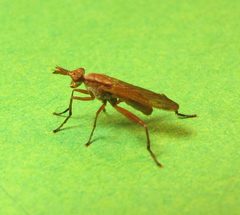
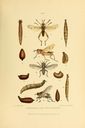
Sepedon fuscipennis is a of marsh fly in the Sciomyzidae. The larvae are aquatic of pulmonate snails, living just beneath the water surface suspended by water- hairs surrounding their . are slender flies with a concave and jutting ; males have distinctive bowed hind tibiae and swollen, toothed hind for grasping females during mating. The species exhibits overlapping during summer with unimodal peaks, and has been studied for its potential in of snail of parasitic .
Pronunciation
How to pronounce Sepedon fuscipennis: /sɛˈpɛdɒn ˌfʊsɪˈpɛnɪs/
These audio files are automatically generated. While they are not always 100% accurate, they are a good starting point.
Identification
Males distinguished from females by bowed hind tibiae and swollen, toothed hind . As a member of Sepedon, separable from other sciomyzid by the combination of and aquatic larval . Among North American Sepedon , S. fuscipennis belongs to a species group defined by shared characteristics; precise identification to species requires examination of subtle morphological features or male genitalia. Twenty Sepedon species are recognized in North America, arranged in species groups based on shared characteristics.
Images
Habitat
Freshwater including backwaters, ponds, streams, rivers, and drainage ditches. occur in swampy areas, along pond edges, and stream or river banks. Water courses need not flow permanently to support both flies and their snail prey. The overwinters as adults, enabling early spring .
Distribution
North America, with confirmed records from central New York. The broader distribution across the continent is implied by its status as a common marsh fly, though specific range boundaries are not well documented in available sources.
Seasonality
active from early spring through late summer, with overlapping during summer months. reaches unimodal peaks during summer. In central New York, Trichogramma activity on S. fuscipennis peaked in late July and early August, suggesting this period represents peak reproductive activity.
Host Associations
- pulmonate snails - preyLarvae are of aquatic air-breathing snails lacking an . Larvae require snails for first and second instars; third instar can take larger snails.
- Trichogramma julianoi - causing up to 43.6% mortality in late July-early August
- Trichogramma sp. near californicum - Also parasitizes S. fuscipennis , most active mid- to late summer
Life Cycle
Holometabolous with aquatic larval stage. Females deposit small numbers of in masses on emergent vegetation. Larvae pass through three instars, feeding on snails; first and second instars require snails, while third instar can consume larger prey. Larval survival and production rates are greater when small snails are abundant. occurs in a floating at water margins. emerge after pupal period of undetermined duration. Adults live more than 3 months in laboratory conditions. Multiple overlapping occur during summer with unimodal peaks.
Behavior
aggregate, with distribution fitting a negative binomial pattern suggesting due to environmental heterogeneity. Larvae hang suspended from the water surface by spiracular hairs while hunting snails. When attacking snails, larvae risk suffocation by mucous secretions and entanglement in snail . Larval survival is not perceptibly decreased by crowding (tested at densities of 25-50 larvae per 254.34 cm²). Males use modified hind legs to grasp females during courtship and mating.
Ecological Role
of aquatic pulmonate snails, potentially regulating snail in freshwater . Has been investigated as a biocontrol agent for snails that serve as intermediate of schistosomes and livestock liver flukes in tropical regions, though field trials have yielded mixed results. by Trichogramma wasps can cause substantial mortality (up to 43.6%), representing a significant top-down mechanism.
Human Relevance
Studied for potential use in of aquatic snails that transmit schistosomiasis and livestock liver flukes. The has been the subject of research to understand factors affecting larval survival and production, including the importance of prey availability and feeding history. Laboratory studies indicate females produce an average of 191 , contributing to understanding of reproductive potential for biocontrol applications.
Similar Taxa
- Sepedon spp.Twenty occur in North America; distinguished by species group characteristics and subtle morphological features, often requiring examination of male genitalia
- Elgiva sundewalliCo-occurring sciomyzid in central New York freshwater , also parasitized by Trichogramma julianoi
- Tetanocera spp.Co-occurring sciomyzid in same , though not necessarily sharing identical ecological requirements
More Details
Population Dynamics
estimates based on mean number per sweep agreed well with mark-release-recapture data, fitting a negative binomial distribution.
Laboratory Longevity
survived more than 3 months in laboratory cages, substantially longer than many dipteran .
Larval Feeding Enhancement
Larval survival and production rates were 'much greater' when larvae were fed once before being released into field conditions, suggesting importance of initial nutritional status.
Sources and further reading
- BugGuide
- Wikipedia
- GBIF taxonomy match
- iNaturalist taxon
- NCBI Taxonomy
- Catalogue of Life
- Encyrtid Holdings | Entomology Research Museum
- Bug Eric: Snail-killing Flies, genus Sepedon
- Buprestidae | Beetles In The Bush | Page 10
- When is an ant not an ant? When it’s a jumping spider, of course! | Beetles In The Bush
- jewel beetles | Beetles In The Bush | Page 9
- Bizarre, beautiful extremes | Beetles In The Bush
- POPULATION DYNAMICS OF SEPEDON FUSCIPENNIS (DIPTERA: SCIOMYZIDAE)
- TRICHOGRAMMA SPP. (HYMENOPTERA: TRICHOGRAMMATIDAE) AS EGG PARASITOIDS OF SEPEDON FUSCIPENNIS (DIPTERA: SCIOMYZIDAE) AND OTHER AQUATIC DIPTERA