
Sepedon
Latreille, 1804
Snail-killing Flies
Species Guides
9- Sepedon americana(American snail-killing fly)
- Sepedon armipes(marsh fly)
- Sepedon borealis
- Sepedon floridensis(Florida snail-killing fly)
- Sepedon fuscipennis(marsh fly)
- Sepedon gracilicornis(snail-killing fly)
- Sepedon neili
- Sepedon pacifica
- Sepedon tenuicornis(marsh fly)
Sepedon is a of marsh flies in the Sciomyzidae, commonly known as snail-killing flies. The genus contains approximately 70 described distributed across multiple subgenera. All species share a distinctive : larvae are obligate or of aquatic pulmonate snails. are slender, elongate flies found in association with freshwater . Several species have been investigated as potential agents for snails that serve as intermediate of schistosomes and other trematode .
Pronunciation
How to pronounce Sepedon: /ˈsɛpɛˌdɒn/
These audio files are automatically generated. While they are not always 100% accurate, they are a good starting point.
Identification
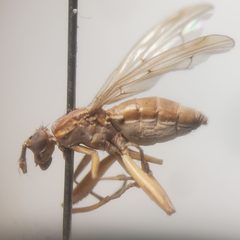
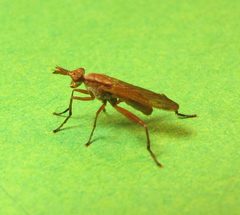
Members of Sepedon can be distinguished from other Sciomyzidae by their slender, elongate body form—often described as 'stretch limo' like—with a concave facial profile and prominent, jutting . Males exhibit distinctive : the hind tibia is bowed and the hind is swollen and armed with teeth, adaptations for grasping females during mating. The is diagnostic when present: capsule-like and boat-shaped, upturned at the end to facilitate floating. -level identification requires examination of subtle morphological characters and is challenging; using the COI gene has proven effective for distinguishing cryptic species.
Images
Habitat
Freshwater and semi-aquatic environments including marshes, ponds, slow-moving streams, rivers, drainage ditches, and backwater . are found along margins of water bodies where emergent vegetation provides oviposition sites. Habitats need not have permanent water flow; temporary pools can support both flies and their snail prey.
Distribution
distribution with recorded from all major biogeographic regions. In North America, approximately 20 species are recognized. Species documented from Africa (including Ethiopia, Benin, South Africa), southern Europe (Spain), India (including Andaman and Nicobar Islands), China (eight species including first record of S. spinipes), and Scandinavia (Denmark, Norway, Sweden).
Seasonality
are active during warmer months with multiple overlapping per year in temperate regions. typically reaches a unimodal peak during summer. Adults overwinter, allowing early season activity; individuals have been observed active as early as February in Colorado Springs. Activity patterns vary by and locality.
Diet
Larvae are obligate malacophages, feeding exclusively on aquatic pulmonate snails. Most are predatory, killing snails quickly and consuming multiple individuals—laboratory studies show larvae can consume 8–50 snails depending on species and prey size. One exception is S. hispanica, whose larvae are during early instars, feeding within living snails of the Succinea before becoming predatory. may feed on honeydew, nectar, or crushed snails; laboratory studies show longest adult longevity when provided with crushed snails plus honey/yeast mixture.
Host Associations
- Bulinus africanus - preyImportant intermediate of Schistosoma haematobium; attacked by S. scapularis
- Bulinus tropicus - preyPrey of S. scapularis in South Africa
- Physa acuta - prey snail preyed upon by S. scapularis
- Succinea elegans - / for first instar larvae of S. hispanica
- Succinea pfeifferi - / for first instar larvae of S. hispanica
- Succinea putris - / for first instar larvae of S. hispanica
- Lymnaea - prey of snails attacked by third instar S. hispanica and other Sepedon
- Physa - prey of snails attacked by third instar S. hispanica and other Sepedon
- Radix balthica - preyLaboratory food source for S. spinipes
Life Cycle
Holometabolous with , three larval instars, pupa, and stages. Females deposit small numbers of eggs in masses on emergent vegetation. Larvae are aquatic, living just beneath the water surface suspended by water- hairs surrounding . First and second instars require small snails as prey; third instars can attack substantially larger snails. Larval development includes risk of suffocation by snail mucous or entanglement of hydrofuge hairs in snail . Mature third instar larvae may engage in wandering prior to . Pupation occurs in a floating, boat-shaped upturned at the posterior end, positioned amidst organic matter at water margins. Adult longevity exceeds 3 months in laboratory conditions. Mean of 191 eggs per female recorded for S. fuscipennis.
Behavior
Larvae exhibit trail-following , using chemical cues to locate snail prey. Aquatic larvae remain suspended at the water surface by specialized hydrofuge hairs on , allowing respiration while submerged. Predatory larvae attack snails lacking an (hardened shell-sealing plate), avoiding 'closed door' defense. S. hispanica larvae exhibit unique behavior in early instars, crawling between mantle and foot of living Succinea snails and remaining for extended periods. aggregate in response to environmental heterogeneity; distributions fit negative binomial models. Males use modified hind legs to grasp females during courtship and mating.
Ecological Role
and of aquatic pulmonate snails, regulating gastropod in freshwater . As malacophages, they occupy a distinctive trophic position linking aquatic detritus-based to terrestrial insect . Potential role in biocontrol of medically and veterinary important snails, though field trials have yielded mixed results. serve as for parasitoid in the Trichogramma, with recorded rates up to 43.6%.
Human Relevance
Investigated as agents for snails that transmit schistosomiasis (human blood fluke ) and fascioliasis (livestock liver fluke disease). S. scapularis identified as potentially useful for control of Bulinus and Physa snails in South Africa. S. nasuta and S. ruficeps evaluated as biocontrol candidates in Benin. S. spinipes studied for temperature optima to facilitate mass culturing for fascioliasis control. Traditional morphological identification is challenging; protocols developed for accurate identification in surveillance and biocontrol programs.
Similar Taxa
- SepedonellaSmall of Sciomyzidae also found in Afrotropical region; distinguished by morphological characters of and stages; S. nasuta was historically placed in subgenus Sepedomyia which has been treated as distinct from Sepedon in some classifications
- Elgiva of Sciomyzidae with similar marsh fly ; E. sundewalli shares and (Trichogramma) with S. fuscipennis; distinguished by morphological features of and larvae
- Tetanocera of Sciomyzidae with aquatic larvae; shares (Trichogramma) and general marsh fly ; larvae differ in prey preferences and morphological details
- Dictya of Sciomyzidae with aquatic, snail-killing larvae; D. montana shares trail-following larval with S. spinipes; distinguished by and larval sensory receptor patterns
Sources and further reading
- BugGuide
- Wikipedia
- GBIF taxonomy match
- iNaturalist taxon
- NCBI Taxonomy
- Catalogue of Life
- Bug Eric: Snail-killing Flies, genus Sepedon
- POPULATION DYNAMICS OF SEPEDON FUSCIPENNIS (DIPTERA: SCIOMYZIDAE)
- Sepedon (Diptera: Sciomyzidae) species from China, with notes on taxonomy and distribution
- DNA Barcoding of Ecologically Important Snail-Killing Flies (Diptera: Sciomyzidae: Sepedon) from India
- The Sepedon sphegea Complex in the Palearctic and Oriental Regions: Identity, Variation, and Distribution (Diptera: Sciomyzidae)
- Dynamique de la population des Sciomyzidae du Sud-Bénin et comparaison de la capacité de prédation des larves de Sepedon (Sepedomyia) nasuta Verbèke, 1950 et celle des larves de Sepedon ruficeps Becker, 1923, deux agents potentiels de biocontrôle de la sc
- Biology of snail-killing flies from Africa and southern Spain (Sciomyzidae: Sepedon)
- Trail-Following Behaviour in the Malacophagous Larvae of the Aquatic Sciomyzid Flies Sepedon spinipes spinipes and Dictya montana
- TRICHOGRAMMA SPP. (HYMENOPTERA: TRICHOGRAMMATIDAE) AS EGG PARASITOIDS OF SEPEDON FUSCIPENNIS (DIPTERA: SCIOMYZIDAE) AND OTHER AQUATIC DIPTERA
- First Record of Snail-Killing Sciomyzids (Diptera: Sciomyzidae) from the Andaman and Nicobar Islands, India, with the Report of Three <i>Sepedon</i> Species
- Life history, immature stages and sensory receptors ofSepedon (Parasepedon) trichrooscelisan Afrotropical snail-killing fly (Diptera: Sciomyzidae)
- Life Cycle and Biology of the Afrotropical Snail-Killing Fly Sepedon (Sepedomyia) nasuta Verbeke (Diptera: Sciomyzidae)
- Snail predation by larvae of Sepedon scapularis Adams (Diptera: Sciomyzidae), a potential biocontrol agent of snail intermediate hosts of schistosomiasis in South Africa
- Sexual dimorphism and the impact of temperature on the pupal and adult stages of Sepedon spinipes spinipes, a potential biological control agent of fascioliasis