
Tetanocera
Latreille, 1804
marsh flies, snail-killing flies, slug-killing flies
Species Guides
7- Tetanocera clara(marsh fly)
- Tetanocera ferruginea(common buff snailkiller)
- Tetanocera melanostigma(marsh fly)
- Tetanocera plebeja(marsh fly)
- Tetanocera plumosa(marsh fly)
- Tetanocera valida
- Tetanocera vicina
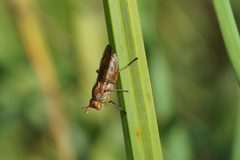
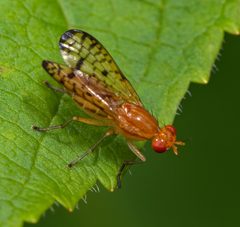
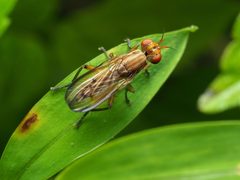
Tetanocera is a of marsh flies ( Sciomyzidae) comprising at least 50 described distributed across temperate regions. Larvae exhibit diverse ecological strategies: some are aquatic of snails, others are terrestrial predators of slugs, and some species show transitional with early instars becoming free-living predators in later instars. The genus has undergone at least three independent transitions from aquatic to terrestrial , with associated in larval . Several species, particularly T. elata, have been investigated as potential agents for agricultural pest molluscs.
Pronunciation
How to pronounce Tetanocera: /ˌtɛtəˈnɒsərə/
These audio files are automatically generated. While they are not always 100% accurate, they are a good starting point.
Identification
identified to by sciomyzid wing venation and body proportions; -level identification requires examination of genitalia and larval characters. Larvae distinguished by association (aquatic vs. terrestrial), cuticular pigmentation, and spiracular disc . Keys to Nearctic larvae and exist based on morphological characters.
Images
Habitat
varies substantially among . Aquatic species inhabit freshwater environments including ponds, marshes, and shorelines. Terrestrial species occupy moist terrestrial habitats including meadows, grasslands, and areas with abundant dead vegetation. T. elata specifically associated with taller dead vegetation and hedgerow proximity in dry meadow systems.
Distribution
Widely distributed across temperate regions of the Northern Hemisphere. Documented from Europe (including Scandinavia: Denmark, Norway, Sweden), Asia (Amur region, China), and North America (including Vermont, USA). Individual show varying ranges: T. elata is Palaearctic; Nearctic fauna well-documented through systematic revisions.
Diet
Larvae are predatory or on molluscs. Aquatic prey on freshwater snails including pulmonates and succineids. Terrestrial species prey on terrestrial slugs; T. elata larvae are obligate mesoparasitoids of Deroceras spp. slugs in first and second instars, becoming free-living in third instar. feeding habits poorly documented.
Host Associations
- Deroceras reticulatum - /preyIdeal prey for T. elata; greatest larval to pupariation
- Deroceras spp. - obligate mesoparasitoid for T. elata first and second instars
- Arion hortensis - preypreferred over Tandonia budapestensis in T. elata feeding trials
- Tandonia budapestensis - preyacceptable but less preferred prey for T. elata
- aquatic pulmonate snails - preyprey for aquatic Tetanocera
- Succineidae - prey of shoreline snails preyed upon by some
Life Cycle
Complete with , three larval instars, , and stages. strategy varies: aquatic have fully larvae; T. elata has first and second instars as obligate mesoparasitoids within slugs, third instar emerges to become free-living . Larval and development rate vary with prey species.
Behavior
Third-instar T. elata larvae show little prey preference, typically attacking first individual contacted. More efficacious on Deroceras reticulatum requiring fewer attacks before feeding compared to other prey. Larvae can survive on alternative prey though with reduced . poorly documented.
Ecological Role
and of molluscs in freshwater and terrestrial . Potential agents for agricultural pest slugs, particularly Deroceras reticulatum. associations suggest role in connecting hedgerow and field-edge ecosystems to agricultural pest suppression.
Human Relevance
Investigated as native agents for programmes against pestiferous slugs in agriculture. T. elata specifically studied for potential development as alternative to chemical molluscicides in slug pest management. sequenced for T. ferruginea (common buff snailkiller).
Similar Taxa
- other Sciomyzidae generaTetanocera distinguished by combination of larval associations (both aquatic and terrestrial), specific mollusc relationships, and characteristic morphological features of stages
- Pherbelliaboth snail-killing sciomyzids; Tetanocera separated by larval and breadth (Tetanocera includes terrestrial )
More Details
Phylogenetic and evolutionary context
Molecular based on one nuclear and three mitochondrial loci indicates aquatic is ancestral for Tetanocera, with at least three parallel transitions to terrestrial habitat and one reversal. Habitat transitions significantly correlated with changes in four larval morphological characters: cuticular pigmentation and three characters associated with spiracular disc. Phylogenetic conservatism maintains aquatic-associated character states; concerted convergence and/or gene linkage implicated in parallel morphological changes.
Research significance
Tetanocera serves as model system for studying of larval and transitions. T. elata is among the most intensively studied for potential, with research spanning nutritional , habitat requirements, larval feeding , and field .
Sources and further reading
- BugGuide
- Wikipedia
- GBIF taxonomy match
- iNaturalist taxon
- NCBI Taxonomy
- Catalogue of Life
- Biology of Slug-Killing Tetanocera (Diptera: Sciomyzidae)1
- Larval feeding behaviour ofTetanocera elata(Diptera: Sciomyzidae): potential biocontrol agent of pestiferous slugs
- Nutritional ecology of predaceous Tetanocera elata larvae and the physiological effects of alternative prey utilisation
- BIOLOGY OF A SLUG-KILLING FLY, <italic>TETANOCERA ELATA</italic> (DIPTERA : SCIOMYZIDAE)
- Parallel evolution of larval morphology and habitat in the snail-killing fly genus Tetanocera
- Field collections and habitat surveys ofTetanocera elata(Diptera: Sciomyzidae) to develop sustainable slug pest management in Ireland
- Biology and immature stages of snail-killing flies belonging to the genus Tetanocera (Insecta: Diptera: Sciomyzidae). 2. Life histories of predators of snails of the family Succineidae
- Biology and immature stages of snail-killing flies belonging to the genus Tetanocera (Insecta: Diptera: Sciomyzidae). 1. Introduction and life histories of predators of shoreline snails
- Biology and immature stages of snail-killing flies belonging to the genus Tetanocera (Insecta: Diptera: Sciomyzidae) 3. Life histories of the predators of aquatic snails
- Biology and Immature Stages of Snail-Killing Flies Belonging to the GenusTetanocera(Diptera: Sciomyzidae). V. Biology of Three Additional Species Having Larvae that Prey on Aquatic Pulmonate Snails
- Biology and Immature Stages Of Snail-Killing Flies Belonging To the Genus Tetanocera (Diptera: Sciomyzidae). IV. Life Histories Of Predators Of Land Snails and Slugs
- Biology and Immature Stages of Snail-Killing Flies Belonging to the GenusTetanocera(Insecta: Diptera: Sciomyzidae). VI. Descriptions of Immature Stages and Keys to the Larvae and Puparia of the Nearctic Species
- Habitat requirements of Tetanocera elata (Diptera: Sciomyzidae): case study of a dry meadow in western Ireland
- Biological control of pestiferous slugs using Tetanocera elata (Fabricius) (Diptera: Sciomyzidae): Larval behavior and feeding on slugs exposed to Phasmarhabditis hermaphrodita (Schneider, 1859)
- The genome sequence of the common buff snailkiller, Tetanocera ferruginea (Fallén, 1820).