
Pherbellia
Robineau-Desvoidy, 1830
snail-killing flies
Species Guides
5- Pherbellia albovaria
- Pherbellia nana
- Pherbellia schoenherri(Spot-winged Little Snailkiller)
- Pherbellia seticoxa
- Pherbellia tenuipes(marsh fly)
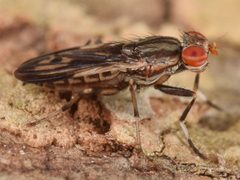
Pherbellia is a of marsh flies in the Sciomyzidae, comprising approximately 95 with a global distribution except the Subantarctic region. The genus is notable for its specialized malacophagous : larvae are or of gastropod mollusks. Species exhibit diverse associations, targeting both terrestrial and freshwater snails across multiple families including land snails (Anguispira, Succinea), glass snails (Zonitoides), pond snails (Stagnicola), and even operculate freshwater snails (Valvata). This genus represents one of the most extensively studied groups within Sciomyzidae regarding .
Pronunciation
How to pronounce Pherbellia: /fɛrˈbɛli.a/
These audio files are automatically generated. While they are not always 100% accurate, they are a good starting point.
Identification
Members of Pherbellia can be distinguished from other Sciomyzidae by morphological features of the male and female terminalia, including the vaginal apodeme—a character used in classification. -level identification often requires examination of wing venation patterns and genitalic structures. The genus is placed within Sciomyzidae by standard dipteran -level characters including single spermatheca in females and characteristic larval cephalopharyngeal skeleton structure.
Images
Habitat
vary by and correspond to those of their gastropod : limestone steppes and xerothermic grasslands (P. limbata), old deciduous forests (P. jalili), pond and marsh edges (P. anubis), and general aquatic or semi-aquatic environments. The occupies both terrestrial and freshwater wherever suitable snail hosts occur.
Distribution
Global distribution excluding the Subantarctic region. Documented from Europe (central and southern), North America, Asia (including Iran, Japan, Korea), Australia, and Africa. Specific regional records include Denmark, Norway, Sweden, and Vermont (USA).
Diet
Larvae are exclusively malacophagous, functioning as or of gastropod mollusks. Feeding strategies vary: some consume multiple snails before pupating in ground litter (P. albocostata: up to five snails), others pupate within the empty shell of the final (P. albovaria), and some are parasitoids that develop within living snails (P. punctata on Succinea putris). Host range spans terrestrial pulmonates, freshwater pulmonates, and operculate freshwater snails.
Host Associations
- Anguispira alternata - preylarval food; terrestrial land snail
- Anguispira fergusoni - preylarval food; terrestrial land snail
- Zonitoides arboreus - preylarval food; glass snail
- Succinea putris - ; amber snail
- Stagnicola palustris - preylarval food; pond snail; multiple Pherbellia
- Valvata sincera - preylarval food; mossy valvata; operculate freshwater snail
- Granaria frumentum - exclusive ; P. limbata only; terrestrial snail
Life Cycle
Complete with four stages: , larva (three instars), pupa, and . Larval development is intimately tied to gastropod . First-instar larvae typically attack snails; development through three instars occurs within or adjacent to hosts. site varies by : within empty snail shells, in ground litter near shells, or in soil. stages have been described for approximately 29 of 96 species, including detailed SEM documentation of egg, all larval instars, and for P. limbata.
Behavior
Larvae exhibit specialized predatory or toward gastropods. Some are active that consume multiple snails sequentially; others are parasitoids that develop within single living . Pupal behavior varies: some species remain within empty shells, others leave shells to pupate in surrounding substrate. behavior poorly documented but presumably involves host-location for oviposition near suitable gastropod .
Ecological Role
Significant and of gastropod , potentially regulating snail densities in both terrestrial and freshwater . Some may function as agents for pest snail species. The specialized malacophagous habit places these flies in a unique trophic position within , linking detrital-based gastropod populations to higher .
Human Relevance
Potential utility as agents for pest gastropods. Scientific interest due to specialized predatory/ lifestyle and as model organisms for studying evolution of parasitoid in Diptera. No documented negative impacts; do not bite or .
Similar Taxa
- SciomyzaAlso in Sciomyzidae with malacophagous larvae; distinguished by morphological features of terminalia and wing patterns
- Other Sciomyzidae generaPherbellia distinguished by combination of vaginal apodeme structure, larval cephalopharyngeal skeleton , and specific associations
Sources and further reading
- BugGuide
- Wikipedia
- GBIF taxonomy match
- NCBI Taxonomy
- Catalogue of Life
- A new species of Pherbellia (Diptera: Sciomyzidae) from Iran
- A SECOND AUSTRALIAN SPECIES OF PHERBELLIA ROBINEAUDESVOIDY (DIPTERA: SCIOMYZIDAE)1
- Life cycles of snaii-killing flies: Pherbellia griseicollis, Sciomyza dryomyzina, S. simplex, and S. testacea (Diptera: Sciomyzidae)
- Biology and immature stages of Pherbellia limbata (Diptera: Sciomyzidae), a parasitoid of the terrestrial snail Granaria frumentum