
Pherbellia schoenherri
(Fallén, 1826)
Spot-winged Little Snailkiller
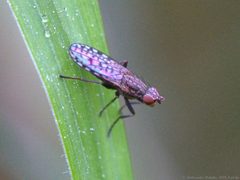
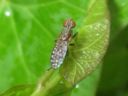
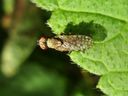
Pherbellia schoenherri is a small snail-killing fly in the Sciomyzidae, distributed across the Palearctic region. measure 4–5 mm and exhibit distinctive wing patterning with spinules on the costal . The is notable for its specialized : females oviposit on the shells of amber snails (Succineidae), particularly Succinea putris, and the larvae consume the animal before pupating within the shell. It is among the most common and widespread Sciomyzidae in Europe, with an exceptionally long period spanning most of the year.
Pronunciation
How to pronounce Pherbellia schoenherri: //fɛrˈbɛl.i.ə ˈʃøːn.hɛr.i//
These audio files are automatically generated. While they are not always 100% accurate, they are a good starting point.
Identification
Diagnostic features include: grey ocellar plate extended in a narrow triangle almost to the antennal base; prescutellar acrostichal bristles reduced or absent; costal of the patterned wings bearing a series of protruding spinules distinct from ordinary bristles. These characters distinguish it from and other small Sciomyzidae.
Images
Habitat
Occurs in a very wide variety of both dry and moist . No specific microhabitat requirements have been documented beyond the presence of suitable snail .
Distribution
Palearctic region. Documented from Belgium (Flemish and Walloon regions), Denmark, Norway, and widespread across Europe.
Seasonality
Main period April to October; in most European countries, occur year-round. This represents one of the longest flight periods known for Sciomyzidae.
Diet
Larvae are of Succineidae (amber snails), specifically documented from Succinea putris. Larvae consume the animal and pupate within the shell. feeding habits are not documented.
Host Associations
- Succinea putris - laid on shell; larvae consume and pupate within shell
- Succineidae - -level association
Life Cycle
Females lay on the exterior of snail shells. Larvae penetrate the shell and consume the animal. occurs within the host shell. Specific developmental rates and voltinism are not documented.
Behavior
Females exhibit shell-seeking oviposition directed at live Succineidae. The ' year-round activity in many regions suggests opportunistic exploitation or overlapping .
Ecological Role
As a of Succineidae, P. schoenherri contributes to of these snails. Succineidae are intermediate for various trematode of livestock and wildlife; thus, P. schoenherri may indirectly influence trematode transmission dynamics, though this has not been quantified.
Human Relevance
No direct economic importance. Potential indirect relevance through suppression of snail that serve as intermediate for liver flukes (Fasciola hepatica) and other trematode of veterinary significance.
Similar Taxa
- Pherbellia species share general body plan and ; distinguished by ocellar plate shape, acrostichal bristle development, and wing spinule patterns
- Other Sciomyzidaesmall size and patterned wings resemble other snail-killing flies; ocellar plate extension and costal spinules are diagnostic for P. schoenherri