
Zodioninae
Rondani, 1857
Genus Guides
2- Robertsonomyia
- Zodion(thick-headed flies)
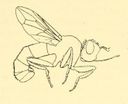
Zodioninae is a of thick-headed flies (Conopidae) within the order Diptera. These flies are , with females known to attack solitary bees and by forcibly depositing into the 's during . The subfamily contains approximately 20 described , most assigned to the Zodion. They are distinguished from other conopids by reduced wing venation and characteristic abdominal .
Pronunciation
How to pronounce Zodioninae: /zoʊˈdaɪoʊnɪniː/
These audio files are automatically generated. While they are not always 100% accurate, they are a good starting point.
Identification
Distinguished from Conopinae by the open or narrowly closed R4+5 in the wing (Conopinae typically have a long cell R4+5). The laterally compressed, stalked differs from the more robust, dorsoventrally flattened abdomen of Physocephala and other conopines. Males lack the elongated fore found in some Conopinae .
Images
Habitat
Open, sunny including meadows, grasslands, forest edges, and gardens. Often found near of solitary bees and , their . frequent flowers for nectar, particularly Asteraceae and Apiaceae.
Distribution
Primarily Holarctic, with greatest diversity in North America and the Palearctic region. Absent from Australia and most of the Neotropics; limited records from southern Africa.
Seasonality
active from late spring through summer, with peak activity in June–August in temperate regions. tracks and availability.
Diet
feed on nectar from flowers. Larvae are endoparasitoids of adult solitary bees (primarily Andrenidae, Halictidae, Colletidae) and some (Sphecidae, Pompilidae), consuming the from within.
Host Associations
- Andrenidae - larval primary
- Halictidae - larval frequent
- Colletidae - larval recorded
- Sphecidae - larval occasional
Life Cycle
Females intercept flying and forcibly oviposit into the host . Larvae develop internally, consuming host tissues; mature larvae exit through host genital chamber or body wall to pupate in soil. Typically , with pupal overwinter.
Behavior
Females exhibit rapid, agile to pursue and intercept bees in mid-air, grappling with the host to insert . are and visit flowers for nectar. Males perch on vegetation and engage in aerial pursuit of females.
Ecological Role
Significant of solitary bees, potentially regulating . nectar feeding contributes to pollination of visited flowers.
Human Relevance
Minimal direct impact. Occasionally observed by beekeepers or researchers. Of interest in studies of and theory.
Similar Taxa
- ConopinaeOverlapping distribution and flower-visiting ; distinguished by wing venation (long R4+5) and more robust, less compressed .
- PhysocephalaLarge conopine with similar -mimicry; differs in wing venation and abdominal shape, and typically attacks different groups (bumble bees, honey bees, social wasps).
More Details
Taxonomic history
Zodioninae was historically treated as a (Zodionidae) by some authors, but molecular and morphological data support its placement as within Conopidae. The group contains the Zodion (majority of ), Physocephalops (Asian), and the fossil genus Archizodion.
Oviposition mechanics
The female reproductive apparatus includes a specialized, chitinized ovipositor adapted for penetrating the 's abdominal wall during aerial pursuit, a unique among Conopidae in its speed and agility.