
Myopa vicaria
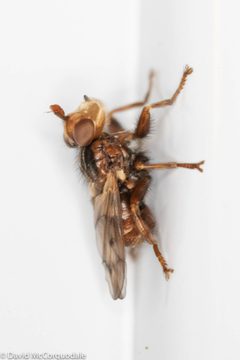
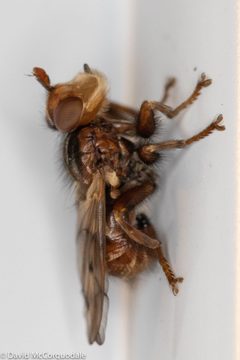
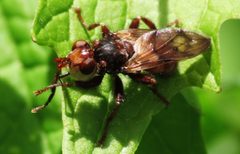
Myopa vicaria is a of thick-headed fly in the Conopidae. Members of this family are internal of bees and , with females intercepting in to oviposit between abdominal segments. The Myopa is generally poorly recorded, likely due to identification difficulties.
Pronunciation
How to pronounce Myopa vicaria: //maɪˈoʊpə vɪˈkɛəriə//
These audio files are automatically generated. While they are not always 100% accurate, they are a good starting point.
Identification
Myopa are recognized by their stout build, broad , and characteristic posture with the partially curved under. Specific diagnostic features for M. vicaria are not documented in available sources. The Myopa is seldom recorded compared to other conopid genera, partly due to identification challenges.
Images
Host Associations
- Andrena barbilabris - possible Specimens of related Myopa tessellatipennis have been found amid mating of this , suggesting a possible link, though this remains unconfirmed for M. vicaria specifically. The and specific host of M. vicaria are unknown.
Behavior
Conopidae females are known as 'beegrabbers' due to their of intercepting bees and in and ovipositing between segments of the host's . The larvae develop internally as . Whether M. vicaria exhibits this behavior specifically has not been directly observed.
Ecological Role
As a of bees and , members of this contribute to of their hymenopteran . The specific ecological impact of M. vicaria is undocumented.
Similar Taxa
- Myopa tessellatipennisBoth belong to the Myopa, which is characterized by stout build, broad , and curved abdominal posture. M. tessellatipennis is distinguished by spotted wings and has been recorded more recently in Ireland.
- Sicus ferrugineusAnother conopid fly commonly encountered in Ireland; differs in -level characteristics and associations.
- Conops quadrifasciatusA commonly recorded conopid that shares the -level lifestyle but belongs to a different with distinct morphological features.