
Physoconops bulbirostris
Loew, 1853
thick-headed fly
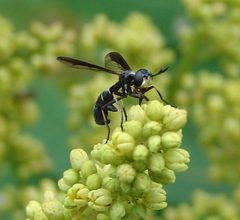
Physoconops bulbirostris is a of thick-headed fly in the Conopidae. Members of this are mimics, resembling potter wasps in body shape and wing coloration. Like other conopids, this species is likely a , with females attacking bees or wasps to deposit . The larva develops internally, eventually killing the .
Pronunciation
How to pronounce Physoconops bulbirostris: /ˌfaɪsoʊˈkoʊnɒps ˌbʌlbiˈrɒstrɪs/
These audio files are automatically generated. While they are not always 100% accurate, they are a good starting point.
Identification
Physoconops closely resemble Physocephala, sharing the -mimicking elongated and pigmented wing margins. Separation of these and identification to species level requires examination of subtle morphological characters not detailed in available sources. The bulbous rostris implied by the specific epithet may be diagnostic, but this has not been confirmed.
Images
Appearance
Body elongated with a constricted waist mimicking potter wasps. disproportionately large relative to body, giving the its . Beak-like mouthparts adapted for nectar feeding. Front margin of wing heavily pigmented, creating the appearance of a longitudinal fold like that seen in resting potter wasps. Specific size and coloration details for this are not documented in available sources.
Habitat
Likely associated with flowering vegetation where seek nectar and . Specific preferences for this are undocumented.
Distribution
North America. Precise range boundaries are not established in available literature.
Seasonality
activity period is not documented for this . Related conopids may have multiple per year in southern climates.
Life Cycle
Presumed to follow the general conopid pattern: female attacks in , depositing between abdominal segments; larva feeds internally as ; occurs within host ; emerges following season. This has not been directly observed for P. bulbirostris.
Behavior
visit flowers for nectar. Females are presumed to seek bees or as , attacking in mid-air and forcing hosts to ground for oviposition. This pattern is inferred from related and has not been confirmed for P. bulbirostris specifically.
Ecological Role
As a presumed of bees or , this may influence . Specific ecological impacts are undocumented.
Human Relevance
No direct human relevance documented. Not known to parasitize humans or domestic animals.
Similar Taxa
- Physocephala tibialisSimilar -mimicking appearance, elongated , and pigmented wing margins. Distinguished by -level characters.
- Zodion intermediumAlso a conopid , but smaller (5-7 mm vs. larger Physocephala/Physoconops) and with different body proportions.
More Details
Taxonomic Note
The specific epithet 'bulbirostris' refers to a bulbous or swollen rostrum, potentially a diagnostic character distinguishing this from .