
Opomyza germinationis
(Linnaeus, 1758)
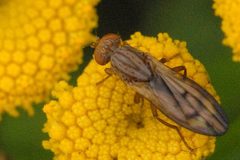
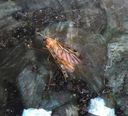
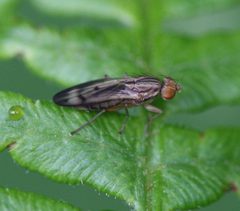
Opomyza germinationis is a fly in the Opomyzidae. The larva is a stem-boring pest of cereals and grasses, feeding on the central shoot and causing 'dead-' in young plants. emerge in mid-summer and persist until early autumn, with oviposition occurring in September-November. The species has been documented as an agricultural pest in Britain and is present in Scandinavia.
Pronunciation
How to pronounce Opomyza germinationis: /ˌɒpoʊˈmaɪzə ˌdʒɜːrmɪnəˈtoʊnɪs/
These audio files are automatically generated. While they are not always 100% accurate, they are a good starting point.
Identification
Larvae can be distinguished from the similar pest by structural features of the skeleton and mouthparts, though both cause comparable 'dead-' damage. are secretive, poor fliers that hide in vegetation, making field detection difficult. The autumn oviposition period and June-July distinguish this from other opomyzids with different .
Images
Habitat
Agricultural fields and grasslands, particularly those with autumn-sown cereals. Larvae inhabit the central shoots of young cereal plants and grasses, feeding internally within stem tissues. occur in vegetation near plants.
Distribution
Documented in Britain (based on detailed bionomic studies), with confirmed presence in Denmark, Norway, and Sweden based on distribution records.
Seasonality
are active from mid-June to early November. Oviposition occurs September-November. Larvae hatch in late autumn and develop slowly through winter. occurs in May, with adults emerging June-July.
Diet
Larvae feed on plant tissues of the central shoot and growing point of young cereals and grasses. Laboratory studies confirm feeding on oat, wheat, barley, Lolium perenne, L. italicum, Dactylis glomerata, Festuca rubra, Poa trivialis, and Cynosurus cristatus. Field observations indicate grasses are the primary , with cereals less frequently infested.
Host Associations
- Triticum aestivum - larval wheat; autumn-sown crops most vulnerable
- Hordeum vulgare - larval barley; autumn-sown crops most vulnerable
- Avena sativa - larval oat; confirmed in laboratory studies
- Lolium perenne - larval ryegrass; primary field
- Lolium italicum - larval Italian ryegrass
- Dactylis glomerata - larval cocksfoot grass
- Festuca rubra - larval red fescue
- Poa trivialis - larval rough meadow-grass
- Cynosurus cristatus - larval crested dog's-tail
Life Cycle
(one per year). emerge mid-June to July and become sexually mature by autumn. are laid September-November on soil surface or between lower leaf of plants. Larvae hatch in late autumn, bore into central shoots, and feed slowly through winter. Development completes by April-May. occurs in the host plant near ground level in May. Adults emerge June-July.
Behavior
are secretive and poor fliers, typically hiding in vegetation rather than flying openly. Larvae feed internally within stems and can migrate between plants if the initial host dies. The larval feeding pattern destroys the growing point while outer leaves often remain green, producing characteristic 'dead-' .
Ecological Role
Agricultural pest causing economic damage to autumn-sown wheat and barley through destruction of growing points. In natural grasslands, larvae feed on native grasses without significant ecological impact documented.
Human Relevance
Recognized agricultural pest in cereal production, particularly for autumn-sown crops in Britain. Larval damage reduces yield through destruction of central shoots. Management strategies are limited by the concealed larval habit and autumn oviposition timing.
Similar Taxa
- Oscinella fritCauses nearly identical 'dead-' damage in cereals; larvae must be dissected and examined for structural differences in skeleton and mouthparts to distinguish
More Details
Historical taxonomic note
Originally described as Musca germinationis by Linnaeus in 1758 before transfer to Opomyza.
Structural study significance
The 1934 anatomical study by Keilin and Tate established this as structurally primitive within Diptera, with reduced skeleton features that have informed understanding of larval evolution in the order.