
Phytomyza opacae
Kulp, 1968
Native holly leafminer
Phytomyza opacae is a leaf-mining fly in the Agromyzidae. It is a herbivore that develops within the leaves of holly (Ilex). The larva creates distinctive serpentine mines visible on leaf surfaces. This species is closely associated with American holly (Ilex opaca) and related Ilex species.
Pronunciation
How to pronounce Phytomyza opacae: /ˌfaɪtoʊˈmaɪzə oʊˈpeɪsi/
These audio files are automatically generated. While they are not always 100% accurate, they are a good starting point.
Identification
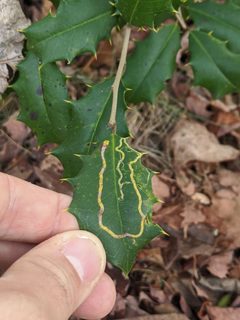
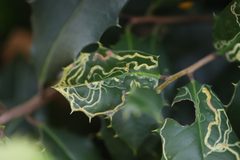
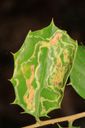
Recognized by the presence of serpentine, snakelike trails (leaf mines) on holly leaves, typically ending in a small circular hole where the emerged. The mines expand in width as the larva grows. Leaves with heavy adult feeding punctures may show curling or puckering. Distinguished from other leaf miners by specificity to Ilex and the characteristic mine pattern.
Images
Habitat
Found in supporting holly trees, including forests, woodlands, and landscaped areas with American holly and related Ilex .
Distribution
Native to eastern North America, associated with the range of its primary , American holly (Ilex opaca).
Seasonality
emerge in spring, timed to coincide with the appearance of tender new holly leaves. Larvae feed through summer, winter, and early spring, with development slowing during cold periods. occurs in spring.
Diet
Larva feeds on nutritious within holly leaves, creating internal mines. female feeds on sap exuded from puncture wounds made with her ovipositor.
Host Associations
- Ilex opaca - primary American holly
- Ilex myrtifolia -
- Ilex cassine - Dahoon holly
- Ilex amelanchier - Swamp holly
Life Cycle
Female deposits through leaf surface into mesophyll using ovipositor. Larva hatches and feeds internally, creating an expanding serpentine mine. Larva overwinters within the leaf, resuming feeding on warm winter days. In spring, larva cuts an escape window in the leaf before pupating. emerges through this window when new holly leaves are available for oviposition. Timing of adult is critical; late emergence prevents successful oviposition on toughened mature leaves.
Behavior
is precisely synchronized with the availability of tender new holly leaves in spring. Female uses ovipositor both for -laying and for creating feeding punctures to access plant sap. Larval feeding is confined to the internal leaf tissue between epidermal layers.
Ecological Role
herbivore that forms a close evolutionary relationship with holly . plant defense includes premature leaf abscission, which can limit leafminer growth by killing developing larvae.
Human Relevance
Considered a minor ornamental pest on American holly in landscapes. Leaf mines and feeding punctures reduce aesthetic value of foliage used for holiday decorations. Does not threaten tree health significantly. Misconception that leaf holes result from spine contact between leaves has been corrected by understanding of adult fly feeding .
Similar Taxa
- Phytomyza ilicicolaAlso a native holly leafminer; historical literature may conflate or confuse these . P. opacae was described by Kulp in 1968, suggesting prior confusion with P. ilicicola in older sources.
Misconceptions
Small holes in holly leaves were once attributed to contact between sharp leaf spines, but are actually caused by female flies puncturing leaves to feed on sap.
More Details
Population regulation
Holly trees regulate leafminer through premature leaf drop when become dense, killing undeveloped larvae.
Taxonomic note
Described by Kulp in 1968; much historical literature on 'native holly leafminer' refers to this or P. ilicicola, sometimes interchangeably.
Sources and further reading
- BugGuide
- Wikipedia
- GBIF taxonomy match
- iNaturalist taxon
- NCBI Taxonomy
- Catalogue of Life
- The Holly and Ivy - A two part series: This week the holly and the native holly leaf miner, Phytomyza ilicicola — Bug of the Week
- Deck the halls with boughs of holly…and the Native holly leafminer, 'Phytomyza ilicicola', and Holly berry midge, 'Asphondylia ilicicola' — Bug of the Week
- Holly surprise: Native holly leafminer, Phytomyza ilicicola — Bug of the Week
- Holiday miners - Native holly leafminer, Phytomyza ilicicola — Bug of the Week
- Deck the halls with boughs of holly - and maybe some leaves with the native holly leafminer, Phytomyza ilicicola — Bug of the Week
- The Holly and Ivy: A two part series - This week the holly and holly leaf miner - Phytomyza ilicicola — Bug of the Week