
Liriomyza blechi
Spencer, 1973
Liriomyza blechi is a leaf-mining fly in the Agromyzidae, first described by Spencer in 1973. The belongs to a group of 27 closely related primarily distributed in the Neotropics, with some extending into temperate North and South America. It is a pest known from diverse plants including maize, various grasses, and dicots in the order Lamiales. Larvae create whitish linear mines in leaves, reducing photosynthetic capacity. The species has been recorded from the United States, Caribbean islands, and Brazil, with expanding documentation of its agricultural impact.

Pronunciation
How to pronounce Liriomyza blechi: //ˌlɪɹiːoʊˈmaɪzə ˈblɛkaɪ//
These audio files are automatically generated. While they are not always 100% accurate, they are a good starting point.
Identification
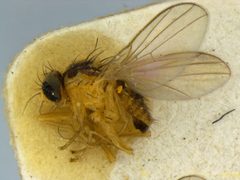
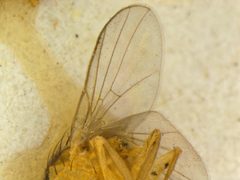
Liriomyza blechi can be distinguished by a yellow with dark bands and spots, yellow scutellum, two small setae in the posteromedial region of the middle tibia, and a long seta at the apex of the . Male genitalia provides definitive identification. Within the L. blechi group, precise identification requires examination of male terminalia and comparison with the 27 recognized species; a taxonomic key is available in Lonsdale (2022).
Images
Habitat
Agricultural and natural areas with plants; recorded from experimental agricultural areas and maize fields. in the L. blechi group occur across Neotropical and temperate regions, suggesting adaptability to varied environments where suitable host vegetation is present.
Distribution
Americas: United States (including Hawaii), Guadeloupe, Dominican Republic, Martinique, Bermuda, Canada, Bolivia, Dominica, Brazil (Pará, Goiás). The has expanded its documented range since initial description, with first Brazilian records from Pará in 2016 and Goiás in 2023.
Diet
Leaf tissue; larvae are leaf miners that feed between upper and lower leaf surfaces.
Life Cycle
to larva to pupa to . Larval and pupal stages develop within leaf mines. occurs inside the mine with projecting outward from the leaf .
Behavior
Creates whitish linear leaf mines with irregular shapes that may or may not follow leaf . Typically only one larva per mine, though multiple mines may occur on a single leaf. Mines impair by damaging leaf tissue.
Ecological Role
Agricultural pest that reduces photosynthetic area of plants. As a , it may also serve as host for , though specific parasitoid associations for this remain undocumented.
Human Relevance
Documented pest of maize (Zea mays) and potentially other crops. The 2023 record from Goiás, Brazil demonstrated damage to maize leaves with irregular mine shapes affecting photosynthetic area. Disjunctive oligophagy—feeding on both monocots (Poaceae) and dicots (Lamiales)—represents a novel usage pattern within Agromyzidae that may facilitate agricultural impact across diverse cropping systems.
Similar Taxa
- Liriomyza huidobrensisAnother leafminer with broad range and agricultural impact; distinguished by thermal limits and distribution patterns
- Liriomyza sativaeVegetable leafminer with overlapping range; L. huidobrensis and L. sativae show competitive displacement patterns that may inform understanding of L. blechi
- Other Liriomyza blechi group species27 recognized in the group require male genitalia examination for definitive identification; many remain poorly known biologically
Sources and further reading
- BugGuide
- Wikipedia
- GBIF taxonomy match
- iNaturalist taxon
- NCBI Taxonomy
- Catalogue of Life
- Liriomyza miserabilis Lonsdale dorsal | Entomology Research Museum
- Primary Type List | Entomology Research Museum
- Publications | Entomology Research Museum
- Liriomyza huidobrensis Archives - Entomology Today
- Predicting Shifts in the Range of Invasive Insect Species in the Face of Climate Change
- A Case for Preservation: Maintaining Insect Collections in Developing Countries
- Revision of the Liriomyza blechi species group (Diptera: Agromyzidae)
- First record of the Liriomyza blechi Spencer (Diptera: Agromyzidae) on maize (Zea mays L.)
- Description of a nomen nudum species of Liriomyza Mik and the first record of Liriomyza blechi Spencer from Brazil (Insecta: Diptera: Agromyzidae)