
Japanagromyza
Sasakawa, 1958
Species Guides
3- Japanagromyza aequalis
- Japanagromyza inaequalis
- Japanagromyza viridula(Oak Shothole Leafminer)
Japanagromyza is a of leaf-mining flies in the Agromyzidae, comprising more than 80 described . Species occur across the Oriental, Afrotropical, Neotropical, and Palaearctic regions. Larvae are internal feeders, with documented habits including leaf-mining and seed-feeding on diverse plants. Several species are recognized as pests of economically or ecologically significant plants, including orchids and legumes.
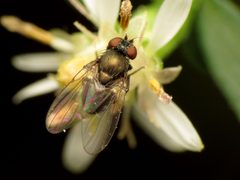
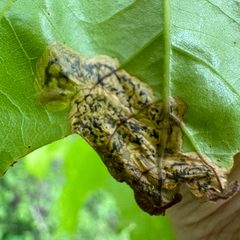
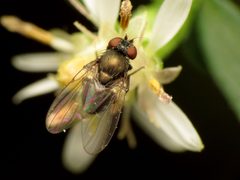
Pronunciation
How to pronounce Japanagromyza: /ˌdʒæpəˌnæɡroʊˈmaɪzə/
These audio files are automatically generated. While they are not always 100% accurate, they are a good starting point.
Identification
are small flies typical of Agromyzidae. -level identification relies heavily on male genitalia, particularly the structure of the ; for example, J. sasakawai has a mesophallus covered with distinctive spine-like processes. External is generally conservative within the , making dissection and microscopic examination necessary for reliable determination.
Images
Habitat
Associated with vegetation supporting larval plants, including leaves of Terminalia catappa (Combretaceae) in the Brazilian Amazon, Populus and Salix in Palaearctic Africa, and diverse orchid in Japan.
Distribution
Widely distributed across tropical and subtropical regions: Oriental region (Thailand, Malaysia, South China, Taiwan, Vietnam), Afrotropical region (including Palaearctic Africa), Neotropical region (Brazil, including the Amazon), and Japan.
Host Associations
- Terminalia catappa L. - leaf-miner of J. sasakawai in Brazil; ornamental plant introduced from Old World tropics
- Populus - leaf-miner of J. salicifolii in Palaearctic Africa
- Salix - leaf-miner of J. salicifolii in Palaearctic Africa
- Crotalaria (Fabaceae) - leaf-miner of J. parvula in Afrotropical region
- Eulophia zollingeri - seed-feeder of J. tokunagai; endangered mycoheterotrophic orchid in Japan
- Multiple orchid species - seed-feederJ. tokunagai documented on 55 orchid across 25 throughout Japan
Life Cycle
Larvae develop internally within plant tissues. Third instar larvae and have been described for some . occurs within the tissue; coarctate pupae and empty puparia have been recovered from herbarium specimens, indicating long-term persistence in plant material.
Behavior
Larval feeding creates internal mines in leaves or feeds within seeds and stems. J. tokunagai exhibits seed-feeding specifically targeting orchid fruits and flowers, causing damage that can reduce reproductive success.
Ecological Role
Larvae function as herbivores, modifying plant tissues through mining or seed . J. tokunagai serves as host for including Gronotoma guamensis (Figitidae) and Pediobius metallicus (Eulophidae), which may regulate fly and indirectly benefit orchid reproductive success.
Human Relevance
J. tokunagai is a serious pest of wild and cultivated orchids in Japan, with historical records extending back to 1923. Some are associated with economically important plants including legumes (Crotalaria) and ornamental species (Terminalia catappa).
Similar Taxa
- Other Agromyzidae generaJapanagromyza is distinguished by genitalic characters, particularly male aedeagal structure; external overlaps broadly with related leaf-mining , requiring dissection for definitive identification.
Sources and further reading
- BugGuide
- Wikipedia
- GBIF taxonomy match
- iNaturalist taxon
- NCBI Taxonomy
- Catalogue of Life
- Japanagromyza Sasakawa (Diptera: Agromyzidae) of Africa
- A review of the Oriental Japanagromyza Sasakawa (Diptera: Agromyzidae), with descriptions of four new species
- A new species of Japanagromyza Sasakawa (Diptera: Agromyzidae) from the Brazilian Amazon with notes on biology
- Immature Stages of Agromyzidae (Diptera) from India. IV. Taxonomy and Biology of Three Species ofJapanagromyzaSasakawa*
- First report that the wasp Gronotoma guamensis (Hymenoptera: Figitidae: Eucoilinae) parasitizes the orchid‐feeding fly Japanagromyza tokunagai in Japan
- Molecular identification of seed‐feeding flies dissected from herbarium specimens clarifies the 100‐year history of parasitism by Japanagromyza tokunagai in Japan
- Pediobius metallicus (Hymenoptera: Eulophidae): First record of a parasitoid wasp of the agromyzid fly Japanagromyza tokunagai, a serious pest of orchids