
Agromyza aristata
Malloch, 1915
elm agromyzid leafminer
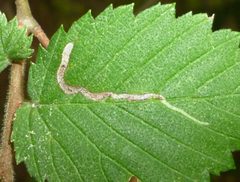
Agromyza aristata is a leaf-mining fly in the Agromyzidae, commonly known as the elm agromyzid leafminer. The creates serpentine leaf mines in elm leaves and shows a strong preference for American elm (Ulmus americana) over Asian elms and hybrids. It is widespread throughout eastern North America and has been documented as a pest in urban landscape settings.
Pronunciation
How to pronounce Agromyza aristata: /ˌæɡrəˈmaɪzə əˈrɪstɑːtə/
These audio files are automatically generated. While they are not always 100% accurate, they are a good starting point.
Identification
are small flies typical of the Agromyzidae. The is distinguished from other elm-feeding agromyzids by its serpentine leaf mine pattern in Ulmus leaves. Larvae can be identified within mines by their characteristic feeding trail. The species can be separated from the related Phytomyza by wing venation and male genitalia characters, though specific diagnostic features for A. aristata require microscopic examination.
Images
Habitat
Urban landscapes, parks, and natural areas with elm trees (Ulmus spp.). Occurs in open, grassy areas where elms are present. Found in both cultivated and wild settings where American elm grows.
Distribution
Widespread throughout eastern North America. Documented in Kentucky (Lexington), Vermont, and across the United States. The ' range corresponds with that of its primary , American elm.
Seasonality
Active during the growing season when elm leaves are available. In Kentucky, leaf mines are initiated in late April and completed by mid- to late May. activity and oviposition occur during spring leaf expansion.
Diet
Phytophagous. Larvae feed internally on leaf mesophyll of elm (Ulmus spp.), creating serpentine mines. Strong preference for American elm (Ulmus americana) documented in field trials; less abundant on Asian elms and hybrids.
Host Associations
- Ulmus americana - primary Strongly preferred; highest mining densities observed on this
- Ulmus parvifolia - secondary Less susceptible; Asian elm with lower rates
- Ulmus propinqua - secondary Less susceptible; Asian elm with lower rates
- Ulmus spp. hybrids - Various - hybrids show intermediate susceptibility
Life Cycle
Larvae develop within serpentine leaf mines in expanding elm leaves. occurs within the mine or in soil. emerge to feed and oviposit. In Kentucky, mines initiated in late April are completed by mid- to late May. New adults emerge by late May and early June.
Behavior
Creates serpentine (winding, linear) leaf mines in elm foliage. Females lay in expanding leaves during spring. Larval feeding produces visible trails as they tunnel through leaf mesophyll between upper and lower . Mines typically widen slightly as larvae mature.
Ecological Role
Leaf-mining herbivore that contributes to foliar damage in elm trees. Acts as a pest in urban landscape settings, reducing aesthetic value of ornamental elms. Part of the guild of leaf-feeding insects associated with Ulmus .
Human Relevance
Considered a pest of ornamental and landscape elms. Contributes to foliar damage in urban tree plantings, particularly on American elm cultivars. Implications exist for re-introduction of elms into urban landscapes, as preference patterns affect cultivar selection for resistance breeding programs.
Similar Taxa
- Phytomyza spp.Other agromyzid leaf miners on Ulmus; distinguished by mine pattern, preference, and
- Kaliofenusa ulmiBlotch-mining on elms; creates blotch mines rather than serpentine mines, and belongs to different order (Hymenoptera)
More Details
Host Resistance Patterns
Field studies in Kentucky demonstrated that A. aristata shows strong preference hierarchy: American elm (Ulmus americana) > hybrid elms > Asian elms. This pattern has implications for elm breeding programs selecting for landscape-suitable, pest- cultivars.
Taxonomic History
described by Malloch in 1915. The specific epithet 'aristata' refers to bristle-like structures, likely on the or body.
Sources and further reading
- BugGuide
- Wikipedia
- GBIF taxonomy match
- iNaturalist taxon
- Catalogue of Life
- Encyrtid Holdings | Entomology Research Museum
- Earth’s oldest living things! | Beetles In The Bush
- Pinaceae | Beetles In The Bush
- Resistance of Landscape-Suitable Elms to Japanese Beetle, Gall Aphids, and Leaf Miners, with Notes on Life History of Orchestes alni and Agromyza aristata in Kentucky