
Cholomyia inaequipes
Bigot, 1884
Cholomyia inaequipes is a tachinid bristle fly described by Bigot in 1884. The is a of weevils in the Conotrachelus, with documented associations to nine species including plum curculio (Conotrachelus nenuphar) and hickory curculio (Conotrachelus juglandis). It occurs across North, Central, and South America.
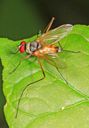
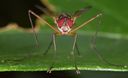
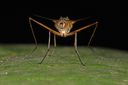
Pronunciation
How to pronounce Cholomyia inaequipes: //kɔˈloʊ.miː.jə ɪˌneɪ.kwɪˈpɛs//
These audio files are automatically generated. While they are not always 100% accurate, they are a good starting point.
Identification
As a member of Tachinidae, this can be recognized by the characteristic bristle fly : a robust body covered with prominent setae, a single pair of functional wings (forewings), and reduced hindwings modified into . Specific diagnostic features for C. inaequipes within the Cholomyia require examination.
Images
Distribution
Canada, United States, Rica, Guatemala, Mexico, Brazil, Colombia, Guyana, Peru, and Venezuela.
Host Associations
- Conotrachelus affinis - Boheman, 1837
- Conotrachelus aratus - Germar, 1824
- Conotrachelus crataegi - Walsh, 1863
- Conotrachelus elegans - Say, 1831
- Conotrachelus juglandis - Le Conte, 1876; hickory curculio
- Conotrachelus naso - Le Conte, 1876
- Conotrachelus nenuphar - Herbst, 1797; plum curculio
- Conotrachelus posticatus - Boheman, 1837
- Conotrachelus retencus - Say, 1831
Life Cycle
As a tachinid , larvae develop internally within weevils, eventually killing the host. Specific details of deposition, larval instars, site, and time have not been documented.
Ecological Role
agent of Conotrachelus weevil pests. The association with C. nenuphar (plum curculio) and C. juglandis (hickory curculio) indicates potential importance in regulating of economically significant fruit and nut tree pests.
Human Relevance
Potential value in of curculionid weevils affecting orchard crops, particularly plum curculio in stone fruit production.
Similar Taxa
- Other Cholomyia speciesCongeneric require examination of male terminalia and other subtle morphological characters for reliable identification.
- Other Tachinidae parasitoids of ConotrachelusMultiple tachinid attack weevil ; host association alone is insufficient for -level identification.
More Details
Host specificity
The broad range across nine Conotrachelus suggests C. inaequipes is a within this weevil rather than host-specific.
Research gaps
Despite documentation of associations, fundamental including oviposition , larval development rates, and environmental requirements remain unstudied.