
Conotrachelus posticatus
Boheman, 1837
Oak Curculio
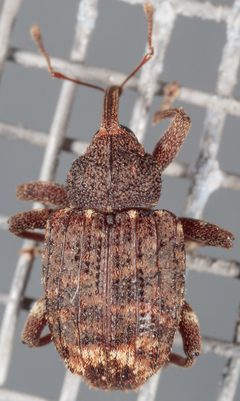
Conotrachelus posticatus is a small weevil (3.7–5 mm) commonly known as the Oak Curculio, native to North America with a range extending from Canada to Panama. The is a on oak acorns, using them for both larval development and feeding. Females oviposit in acorn seeds, and larvae complete development inside the nut, passing through five instars over 10–30 days depending on species. Adults emerge in late spring and early summer, with a second winter spent hibernating under leaf litter. The species possesses a stridulatory mechanism for sound production and has been identified as a potential threat to the avocado industry, though its primary ecological role involves oak seed with complex implications for forest .
Pronunciation
How to pronounce Conotrachelus posticatus: /ˌkɒnoʊˈtræʃələs ˌpɒstɪˈkeɪtəs/
These audio files are automatically generated. While they are not always 100% accurate, they are a good starting point.
Identification
Distinguished from by combination of: longitudinal prothoracic carina; mesosternum with anterolateral angles and prominent; densely punctate . Closely resembles C. lobatus (northern Mexico), C. carinifer, and C. naso, with which it shares the median prothoracic carina and mesosternal characters. Stridulatory patterns differ demonstrably from other Conotrachelus in frequency and speed characteristics.
Images
Appearance
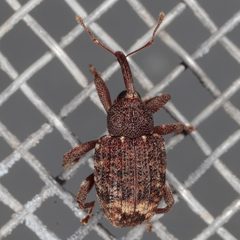
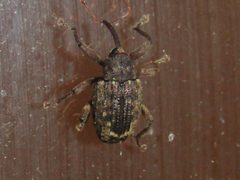
Small weevil measuring 3.7–5 mm in length. Body coloration dark reddish-brown to black. densely punctate. Rostrum elongated, elephant trunk-like in appearance, with chewing mouthparts at the end. Possesses elytral stridulitra and plectra used for sound production.
Habitat
Oak-dominated forests and woodlands. Breeds specifically within acorns of oak trees (Quercus spp.). hibernate under leaf litter on the forest floor; larvae overwinter in soil. Associated with bottomland forests where spring-germinating acorns occur on soil surface.
Distribution
Native to North America, ranging from Canada (New Brunswick, Nova Scotia, Ontario, Québec) through the United States (documented from Minnesota, Florida, Texas) south to Panama.
Seasonality
emerge in late spring and early summer for oviposition. Larval development occurs summer through fall. Adults pass second winter in hibernation; longevity beyond second winter undetermined.
Diet
Larvae feed exclusively on internal tissues of acorn seeds. feed on acorn tissues. Documented breeding in acorns of at least nine oak , with highest reproductive success in black oak acorns. Laboratory observations indicate feeding and oviposition in Crataegus fruits and fresh hickory nuts, though black oak acorns support greatest larval production.
Host Associations
- Quercus - breeding nine documented; black oak preferred
- Quercus macrocarpa - breeding bur oak; larval 14 days
- Crataegus - laboratory feeding/ovipositionnot primary
- Carya - laboratory feeding/ovipositionfresh hickory nuts
Life Cycle
Complete . Female oviposits in acorn seed. develops into larva passing through five instars. Larval stage duration 10–30 days depending on acorn (14 days in bur oak, 30 days in black oak). Larvae exit acorns to pupate in soil, where they overwinter. emerge late spring/early summer, oviposit in acorns, and pass second winter as adults under leaf litter. Voltinism pattern not fully resolved; possibly semivoltine with two-year cycle.
Behavior
stridulate by scraping elytral stridulitra against plectra, producing variable frequencies and speeds. Sound production induced by agitation or handling. Adults hide from by burrowing into soil, often after chewing exit hole in acorn. Females preferentially oviposit in damaged acorns.
Ecological Role
Secondary acorn . Reduces viable oak seed stock, potentially threatening oak . Simultaneously facilitates bottomland forest regeneration by infesting 20–65% of spring-germinating acorns on soil surface, potentially influencing seedling establishment dynamics. Predators of C. posticatus indirectly reduce threat to oak trees.
Human Relevance
Identified as one of seven Curculionidae threatening the avocado industry, though primary economic impact is on oak seed production rather than commercial agriculture. Potential significance for oak forest management and restoration. Confusion with related Conotrachelus species has implications for detection and protocols.
Similar Taxa
- Conotrachelus lobatusSimilar and geographic overlap in northern Mexico; distinguished by subtle differences in rostral and prothoracic characters
- Conotrachelus cariniferShares longitudinal prothoracic carina and prominent mesosternal anterolateral angles; specific distinguishing features require detailed examination
- Conotrachelus nasoOverlapping range (both found in Panama), similar oviposition , and comparable larval patterns, formation, and prepupal/pupal activity; stridulatory patterns and specific morphological details differ
More Details
Stridulatory biology
Produces sound through elytral stridulitra-plectra mechanism with individually variable frequencies and speeds, distinct from congeneric .
Research history
Initial research focused on Ohio acorn ; subsequent work expanded to broader U.S. oak . remains incompletely known despite taxonomic description in 1837.