
Conotrachelus nenuphar
Harris, 1841
Plum Curculio
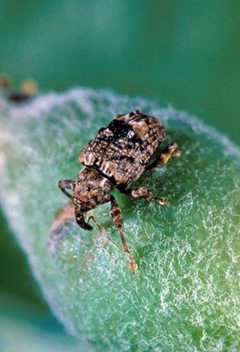
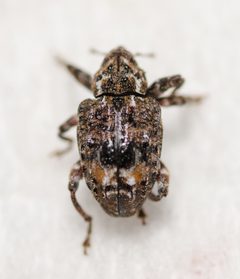
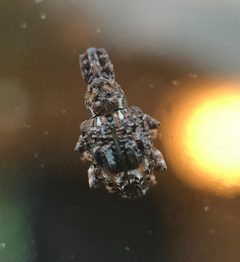
The is a native North American weevil and economically significant pest of stone and pome fruits. It has been documented as a fruit pest since the 18th century and remains a primary challenge for orchard production east of the Rocky Mountains. The exhibits geographic variation in voltinism, with in northern regions and multivoltine populations in the south.
Pronunciation
How to pronounce Conotrachelus nenuphar: /ˌkoʊnoʊˈtrækələs ˈnɛnʊfɑr/
These audio files are automatically generated. While they are not always 100% accurate, they are a good starting point.
Identification
A small true weevil with the characteristic elongated snout (rostrum) typical of Curculionidae. Specific diagnostic features distinguishing it from other Conotrachelus are not provided in available sources.
Images
Habitat
Agricultural including orchards of stone fruits (Prunus spp.), pome fruits (Malus, Pyrus), and blueberry. Overwinters primarily in woodland areas adjacent to orchards, with spring to fruit-growing regions.
Distribution
to North America east of the Rocky Mountains. Documented in Canada (Manitoba, New Brunswick, Newfoundland, Nova Scotia, Ontario, Prince Edward Island, Quebec) and the United States (Alabama, Arkansas, Colorado, Connecticut, Delaware, Florida, Georgia, Illinois, Indiana, Iowa, Kansas, Kentucky, Louisiana, Maine, Maryland, Massachusetts, Michigan, Minnesota, Mississippi, Missouri, Montana, Nebraska, New Hampshire, New Jersey, New York, North Carolina, North Dakota, Ohio, Oklahoma, Pennsylvania, Rhode Island, South Carolina, South Dakota, Tennessee, Texas, Utah, Vermont, Virginia, West Virginia, Wisconsin).
Seasonality
emerge from sites in spring and disperse to orchards. Activity shifts from primarily before fruit set to as fruits become available for oviposition. Summer emerges in August in northern regions. Northern undergo obligate winter reproductive .
Diet
Oligophagous, feeding on rosaceous including stone fruits (peach, apricot, nectarine, plum), pome fruits (apple, pear), and blueberry. feed on fruit exterior; larvae feed internally on developing fruit.
Host Associations
- Prunus persica - peach
- Prunus armeniaca - apricot
- Prunus spp. - stone fruits
- Malus pumila - apple
- Pyrus communis - pear
- Vaccinium - blueberry in some regions
- Prunus mume - first reported
Life Cycle
Complete . oviposit into developing fruit, creating crescent-shaped scars. Larvae develop internally, feeding on fruit flesh. Mature larvae exit dropped fruit and pupate in soil. to adult requires approximately one month. Northern strain is with obligate winter ; southern strain is multivoltine. Full-grown larvae in dropped fruit in June ("June drop") enter soil to pupate.
Behavior
exhibit cyclic movement within trees in spring. Before fruit set, adults are primarily ; activity extends to daytime when fruits become available for oviposition. Summer adults feed on remaining fruit through fall before dispersing to sites. Protein immunomarking studies indicate adults can be tracked without behavioral disruption. Females climb significantly greater distances than males.
Human Relevance
Major economic pest of fruit production causing three damage types: feeding scars, oviposition scars on fruit exterior, and internal larval feeding leading to premature fruit abortion (June drop). Near-complete crop loss can occur if left untreated. Subject of extensive research including discovery, trap tree methods, and applications. Pyriproxyfen can artificially terminate reproductive in northern strain for laboratory rearing.
More Details
Voltinism Variation
Geographic strains differ in : northern are with obligate winter reproductive , while southern populations are multivoltine.
Historical Significance
First described damage to domesticated fruit dates to the 18th century. The last comprehensive review prior to 2021 was published in 1912 (The ).
Management Challenges
Control is complicated by larval development inside fruit, unpredictable , lack of effective commercially available biocontrol agents, and absence of convenient reliable monitoring techniques for spray timing.
Sources and further reading
- BugGuide
- GBIF taxonomy match
- iNaturalist taxon
- NCBI Taxonomy
- Catalogue of Life
- Plum Curculio Conotrachelus Nenuphar - Entomology Today
- Plum Curculio: New Guide Gathers IPM Recommendations for North American Fruit Pest
- Conotrachelus nenuphar Archives - Entomology Today
- Plum curculio, Conotrachelus nenuphar (Herbst)
- Conotrachelus nenuphar . [Distribution map].
- Conotrachelus nenuphar (plum curculio).
- Conotrachelus nenuphar . [Distribution map].
- Spatial and Temporal Distribution of Oviposition by Plum Curculios, Conotrachelus nenuphar
- Ecology and management of plum curculio, Conotrachelus nenuphar [Coleoptera :Curculionidae], in apple orchards
- Physiological Parameters of Diapause and Reproduction in the Plum Curculio, Conotrachelus nenuphar (Herbst) (Coleoptera: Curculionidae)
- Life-History and Ecology of the Plum Curculio, Conotrachelus nenuphar (Hbst.) (Coleoptera: Curculionidae), in the Niagara Peninsula, Ontario
- First Report of Prunus mume Siebold & Zucc. as a Host of Conotrachelus nenuphar (Herbst) (Coleoptera: Curculionidae)
- Behavioral Effects and Retention of Protein Immunomarkers on Plum Curculio Conotrachelus nenuphar (Coleoptera: Curculionidae)
- Corrigendum to: Behavioral Effects and Retention of Protein Immunomarkers on Plum Curculio Conotrachelus nenuphar (Coleoptera: Curculionidae)
- Cyclic behavior of plum curculio,Conotrachelus nenuphar (Herbst) (Coleoptera: Curculionidae), within caged dwarf apple trees in spring
- Pyriproxyfen activates reproduction in prediapause northern strain plum curculio (Conotrachelus nenuphar Herbst)
- Hosts of Plum Curculio,Conotrachelus nenuphar(Coleoptera: Curculionidae), in Central Georgia
- Behavioral and electroantennogram responses of plum curculio, Conotrachelus nenuphar, to selected noxious plant extracts and insecticides