
Linnaemya
Robineau-Desvoidy, 1830
Species Guides
1Linnaemya is a of tachinid flies (Diptera: Tachinidae) comprising approximately 130 described distributed across three recognized subgenera: Homoeonychia, Linnaemya (sensu stricto), and Ophina. Species are predominantly of lepidopteran larvae, particularly Noctuidae (owlet moths), with some records from other groups. The genus exhibits a broad geographic range spanning the Palaearctic, Oriental, Afrotropical, and Nearctic regions. Several species have been subjects of genomic sequencing due to their ecological significance as agents.
Pronunciation
How to pronounce Linnaemya: /lɪˈneɪmiə/
These audio files are automatically generated. While they are not always 100% accurate, they are a good starting point.
Identification
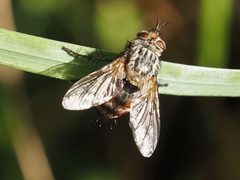
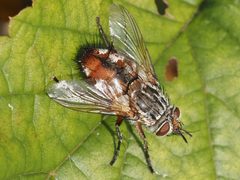
identification to level requires careful examination of morphological characters including bristle patterns, coloration of legs and , and male genitalia structure. Some species pairs are notably difficult to separate without dissection; for example, Linnaemya tessellans requires careful comparison with L. rossica and L. pica. The subgenus Ophina species tend to be more slender with different abdominal coloration patterns compared to subgenus Linnaemya. Molecular identification using COI sequences has been employed for taxonomic placement, particularly for newly described species.
Images
Habitat
varies by and region. Documented habitats include deciduous woodland (L. tessellans in Wytham Woods, Oxfordshire), heathland (L. vulpina), and Finnish Lapland tundra environments (L. bergstroemi). As a , species occupy diverse terrestrial habitats across temperate, , and tropical zones.
Distribution
Widely distributed across multiple biogeographic regions: Palaearctic (Europe, Central Asia, Western Russia, Siberia, Transcaucasia, Middle East, China), Oriental Region (West China, Taiwan, Southeast Asia), Afrotropical Region (sub-Saharan Africa), and Nearctic Region (North America). In Europe, distribution ranges from Scandinavia to the Mediterranean, with some reaching into the Arctic. In Britain and Ireland, occurrence varies from widespread and common (L. vulpina) to locally distributed and sparingly recorded (L. tessellans).
Seasonality
periods vary by and latitude. Linnaemya tessellans is double-brooded with spring peaking in late May and summer brood peaking in mid-August, with adults on the wing from early May to early October. Linnaemya vulpina adults fly June through September, occasionally extending into October. Specific seasonality data for most species is limited.
Host Associations
- Lycophotia porphyrea - L. vulpina larval ; Noctuidae
- Chilodes maritimus - L. vulpina larval ; Noctuidae
- Archanara geminipuncta - L. vulpina larval ; Noctuidae
- Blepharita satura - L. vulpina larval ; Noctuidae
- Spodoptera littoralis - L. vulpina larval ; Noctuidae
- Mythimna loreyi - L. vulpina larval ; Noctuidae
- Xestia c-nigrum - Questionable record for L. tessellans; cited as 'questionable' in Belshaw (1993)
Life Cycle
Larvae are internal of lepidopteran caterpillars, primarily Noctuidae. In Linnaemya vulpina, the involves deposition of an incubated on a leaf. The highly sclerotised larva remains attached by its end to the egg capsule while making pendulum-like movements with its end. Upon contact with a passing lepidopteran larva, it attaches and bores into the . Development occurs within the host caterpillar. Specific life cycle details for most are undocumented.
Behavior
includes -seeking for oviposition. Larval behavior includes active host location through pendulum-like movements while attached to the capsule, as documented in L. vulpina. Adults of some require careful examination to distinguish from , suggesting potential mimicry or convergent appearance within the .
Ecological Role
agent of lepidopteran , particularly Noctuidae (owlet moths), through larval activity. The contributes to natural regulation of populations in diverse including woodlands, heathlands, and agricultural areas.
Human Relevance
Potential significance in of pest , particularly Noctuidae that include agricultural pests. Genomic resources have been developed for at least two species (L. tessellans and L. vulpina) to support research on and potential biocontrol applications.
Similar Taxa
- BonellimyiaSubgenus-level taxonomic similarity; some Linnaemya have been historically associated with or compared to Bonellimyia based on morphological and molecular characters
- OphinaHistorically recognized as a distinct , now treated as a subgenus within Linnaemya; share lifestyle but differ in body form and abdominal coloration
More Details
Genomic Resources
-level assemblies have been published for Linnaemya tessellans (709.9 Mb, 7 chromosomal pseudomolecules, 17.24 kb mitochondrial genome) and Linnaemya vulpina (554.00 Mb, 7 chromosomal pseudomolecules, 16.72 kb mitochondrial genome, 11,599 protein-coding genes). These resources support research on fly and evolution.
Taxonomic Subdivisions
The is divided into three subgenera: Homoeonychia Brauer & von Berganstamm, 1889; Linnaemya Robineau-Desvoidy, 1830; and Ophina Robineau-Desvoidy, 1863. A substantial number of (approximately 50) remain unplaced to subgenus. The subgenus Bonellimyia Townsend has been synonymized or reclassified in recent treatments.
Sources and further reading
- BugGuide
- Wikipedia
- GBIF taxonomy match
- iNaturalist taxon
- NCBI Taxonomy
- Catalogue of Life
- Linnaemya bergstroemi n. sp. (Diptera: Tachinidae)—a new parasitoid fly from the Finnish Lapland
- The genome sequence of a tachinid fly, Linnaemya vulpina (Fallén, 1810).
- The genome sequence of a tachinid fly, Linnaemya tessellans (Robineau-Desvoidy, 1830).