
Istocheta aldrichi
(Mesnil, 1953)
Winsome Fly
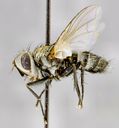
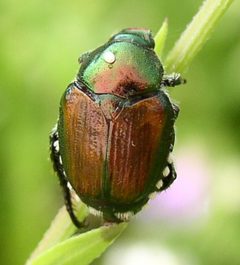
Istocheta aldrichi is a tachinid fly native to Japan that was introduced to North America in 1922 as a agent against the Japanese beetle (Popillia japonica). The has established throughout northeastern North America and has recently expanded its range into Quebec, Ontario, and the Midwest United States. It is a highly -specific that deposits large white macrotype on the pronotum of , with larvae developing internally and causing host death within 5–7 days of egg hatch. Recent studies demonstrate rates of 15–60% in some areas, making it an important natural enemy for .
Pronunciation
How to pronounce Istocheta aldrichi: //ˌɪstoʊˈkiːtə ˈɔːldrɪkaɪ//
These audio files are automatically generated. While they are not always 100% accurate, they are a good starting point.
Identification
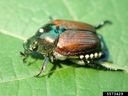
Distinguished from other tachinid of scarab beetles by the deposition of large, visible white on the pronotum of rather than concealed microtype eggs. In North America, it is the only known tachinid parasitoid specifically targeting Popillia japonica adults with this egg type. (multiple eggs per host) is common, with up to 8 eggs observed on single beetles, though typically only one larva completes development. Presence of white spherical eggs on the pronotum of is diagnostic for field identification.
Images
Appearance
flies are small tachinids with typical bristle fly . Females deposit large, spherical, white macrotype externally on the 's pronotum. These eggs are conspicuous and visible to the naked , distinguishing this from many other tachinids that deposit microtype eggs. Larvae are internal developing within the host . are formed either within the host cadaver or after larvae exit the host.
Habitat
Occurs in supporting of its , the Japanese beetle, including commercial orchards, vineyards, raspberry fields, agricultural crops, and urban landscapes with roses, linden trees, and other host plants. pupae are found in soil substrates. flies are active in areas where adult aggregate on foliage.
Distribution
Native to Japan, Korean Peninsula, Russia, and Taiwan. Introduced to North America in 1922 and established in northeastern United States and Canada. Range has expanded significantly in the past decade, now present throughout southern Quebec, Ontario, and the Midwest United States including Minnesota. Established in most areas of Quebec where Japanese beetle occurs, distributed along the St. Lawrence River and southern regions of the province.
Seasonality
activity coincides with adult Japanese beetle , typically from late June through mid-July in northeastern North America. peaks before the peak. Adult emergence from overwintered pupae is determined by cumulative above 10°C starting from April 1st. Collection of parasitized hosts yields declining pupariation success as the season progresses.
Host Associations
- Popillia japonica (Japanese beetle) - Highly specific of ; deposited on pronotum, larvae develop internally causing death
Life Cycle
Endoparasitic development with free-living stage. hatch on pronotum and larvae penetrate to develop within host and . Larvae cause cessation of host feeding within 3–5 days and host death within 5–7 days of egg hatch. Larvae either pupate inside host cadaver or exit to pupate in soil 14–20 days post-collection. Overwinters as pupae in soil. Cold exposure duration during increases adult success and reduces post-winter development time. Burying in soil in late summer or early fall improves subsequent adult emergence.
Behavior
Females exhibit efficient searching at low densities, enabling high rates even when Japanese beetle are sparse. is common, with multiple deposited on single hosts, though typically only one larva successfully develops. Parasitized hosts cease feeding rapidly, reducing crop damage even before host death. longevity is extended by cooler temperatures and provision of honey-water; pollen alone or combined with honey-water reduces longevity compared to honey-water alone.
Ecological Role
Important agent and natural enemy of the Japanese beetle, an economically significant pest of over 300 plant . Reduces feeding damage through rapid feeding cessation in parasitized beetles. Contributes to sustainable, non-insecticidal management of Japanese beetle in agricultural and urban settings. High host specificity minimizes ecological risk to non-target scarab species.
Human Relevance
Used in programs since 1922 to manage Japanese beetle without chemical . Currently being evaluated for additional releases in North America and Europe where Japanese beetle is establishing. Research focuses on improving rearing techniques, including trap modifications for efficient collection and optimized conditions for pupae. sequencing (875.3 Mbp assembly) facilitates future research on biocontrol potential and comparative of flies.
Similar Taxa
- Other Tachinidae parasitoids of ScarabaeidaeMany tachinids parasitize scarab beetles but deposit concealed microtype rather than the conspicuous macrotype eggs on the pronotum characteristic of I. aldrichi
- Istocheta spp. may share similar but differ in specificity and geographic distribution; I. aldrichi is distinguished by its specific association with Popillia japonica in its introduced range
More Details
Genomic characteristics
Reference assembly of 875.3 Mbp in 1,041 scaffolds with N50 of 4.77 Mbp and 99.5% complete Diptera BUSCOs. Comparative across 19 tachinid reveals I. aldrichi has relatively high gene expansions, many predicted to function in metal ion transport, contrasting with gene family contractions in other tachinid lineages. Complete mitogenome also available.
Non-target specificity
Analysis of over 21,000 crowdsourced observations of non-target scarab beetles within I. aldrichi's range found candidate on non-target represented less than 0.001% of all observations, with no single non-target species exceeding 1.3% observation rate. This provides strong evidence for negligible non-target effects from this century-old introduction.
Rearing optimization
Modified commercial traps with larger ventilated containers, added food sources, and substrate collect more beetles and improve development. Withholding food from parasitized slightly increases yield but reduces puparium weight. Spring can be staggered through controlled temperature manipulation without reducing success.
Sources and further reading
- BugGuide
- Wikipedia
- GBIF taxonomy match
- iNaturalist taxon
- NCBI Taxonomy
- Catalogue of Life
- Encyrtid Holdings | Entomology Research Museum
- Abundance of Japanese beetle adults and its parasitoid Istocheta aldrichi in a Quebec commercial vineyard
- The genome of Istocheta aldrichi (Diptera: Tachinidae), a parasitoid of the Japanese beetle, Popillia japonica (Coleoptera: Scarabaeidae)
- The genome of Istocheta aldrichi (Diptera: Tachinidae), a parasitoid of the Japanese beetle, Popillia japonica (Coleoptera: Scarabaeidae)
- Rearing Istocheta aldrichi (Diptera: Tachinidae) from field-collected Japanese beetles ( Popillia japonica ): 1. Methods to improve insect collection and parasitoid pupariation
- The establishment of the association between the Japanese beetle (Coleoptera: Scarabaeidae) and the parasitoid Istocheta aldrichi (Diptera: Tachinidae) in Québec, Canada
- Crowdsourced online data as evidence of absence of non-target effects from the century-old introduction of Istocheta aldrichi for biological control of Popillia japonica in North America
- Figure 1 from: Lasnier J, de Coussergues C-H, Baril A, Vincent C (2025) Abundance of Japanese beetle adults and its parasitoid Istocheta aldrichi in a Quebec commercial vineyard. Bulletin of Insectology 78: 1-10. https://doi.org/10.3897/bull.insectology.152754
- Figure 5 from: Lasnier J, de Coussergues C-H, Baril A, Vincent C (2025) Abundance of Japanese beetle adults and its parasitoid Istocheta aldrichi in a Quebec commercial vineyard. Bulletin of Insectology 78: 1-10. https://doi.org/10.3897/bull.insectology.152754
- Rearing Istocheta aldrichi (Diptera: Tachinidae) from field-collected Japanese beetle ( Popillia japonica ): 2. Methods to improve overwintering, adult emergence and longevity
- Figure 3 from: Lasnier J, de Coussergues C-H, Baril A, Vincent C (2025) Abundance of Japanese beetle adults and its parasitoid Istocheta aldrichi in a Quebec commercial vineyard. Bulletin of Insectology 78: 1-10. https://doi.org/10.3897/bull.insectology.152754
- Crowdsourced online data as evidence of absence of non-target attack from the century-old introduction of Istocheta aldrichi for biological control of Popillia japonica in North America
- Figure 4 from: Lasnier J, de Coussergues C-H, Baril A, Vincent C (2025) Abundance of Japanese beetle adults and its parasitoid Istocheta aldrichi in a Quebec commercial vineyard. Bulletin of Insectology 78: 1-10. https://doi.org/10.3897/bull.insectology.152754
- Figure 2 from: Lasnier J, de Coussergues C-H, Baril A, Vincent C (2025) Abundance of Japanese beetle adults and its parasitoid Istocheta aldrichi in a Quebec commercial vineyard. Bulletin of Insectology 78: 1-10. https://doi.org/10.3897/bull.insectology.152754