
Istocheta
Rondani, 1859
Species Guides
1- Istocheta aldrichi(Winsome Fly)
Istocheta is a of tachinid flies (Diptera: Tachinidae) in the tribe Blondeliini. The genus contains approximately 30 described distributed across the Palearctic and Nearctic regions. Istocheta aldrichi, the most extensively studied species, is a of the Japanese beetle (Popillia japonica) and has been widely introduced as a agent. Most species in the genus appear to be parasitoids of scarab beetles, though detailed records remain limited for many .
Pronunciation
How to pronounce Istocheta: //ˌɪstoʊˈkiːtə//
These audio files are automatically generated. While they are not always 100% accurate, they are a good starting point.
Identification
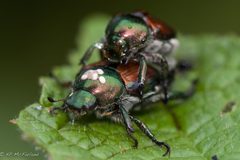
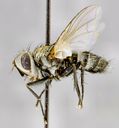
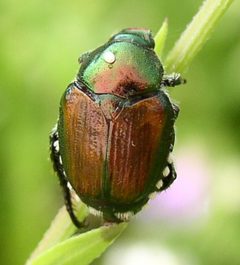
Members of Istocheta can be distinguished from other Blondeliini by the combination of a bare or nearly bare postscutellum, absence of strong presutural dorsocentral setae, and characteristic male terminalia with distinct surstyli. Istocheta aldrichi is recognizable by its small size (4–6 mm), predominantly black body with pale yellowish , and the distinctive large, spherical, white macrotype that females deposit on beetles. Separation from the related Cylindromyia requires examination of chaetotaxy and wing venation details.
Images
Habitat
are determined by distribution. For I. aldrichi, this includes agricultural landscapes, vineyards, orchards, urban parks, and suburban gardens where occur. Other have been recorded from forested and grassland habitats across northern Eurasia.
Distribution
The has a trans-Palearctic distribution with extensions into the Nearctic region through intentional introductions. Istocheta aldrichi is native to Japan and was introduced to the northeastern United States in the 1920s; it has subsequently spread across eastern and midwestern North America, including Quebec, Ontario, and Minnesota. Other occur across Europe, Russia, and central Asia.
Seasonality
I. aldrichi emerge in spring following as pupae, with triggered by accumulated above 10°C from April. Oviposition occurs from late June through mid-July in temperate North America, preceding peak Japanese beetle . Adult activity spans approximately 6–8 weeks in summer.
Host Associations
- Popillia japonica - primary of ; deposited on pronotum, larvae develop internally
- Scarabaeidae - Other Istocheta likely parasitize scarab beetles, though specific records are sparse
Life Cycle
Istocheta aldrichi overwinters as pupae in soil or remains. emerge in spring when temperatures permit. Females are , depositing large macrotype directly onto adult host beetles. Eggs hatch in 1–2 days; larvae penetrate the host and develop internally within the and . Larval development requires 14–20 days, after which larvae exit to pupate in soil. occurs but typically only one larva completes development per host. Host death occurs 5–7 days after egg hatch.
Behavior
Females exhibit -searching concentrated at low host densities, suggesting efficient location of sparse Japanese beetle . Oviposition is highly stereotyped: are placed specifically on the pronotum of host beetles, where they are visible to observers. Parasitized host beetles cease feeding within 3–5 days, reducing plant damage even before host death. are and active in warm conditions.
Ecological Role
Istocheta aldrichi functions as a agent of the Japanese beetle, achieving rates of 15–60% in some North American and contributing to suppression of pest in agricultural and horticultural systems. The demonstrates high specificity with negligible non-target effects on native scarab beetles, as evidenced by analysis of over 21,000 field observations.
Human Relevance
I. aldrichi was introduced to North America in 1925–1933 as a agent against the Japanese beetle and remains in active use. The has been proposed for introduction to Europe where P. japonica is expanding. Research applications include genomic studies (reference published, 875.3 Mbp assembly) and development of mass-rearing protocols for augmentative biocontrol.
Similar Taxa
- CylindromyiaSimilar Blondeliini with bare postscutellum; distinguished by chaetotaxy, wing venation, and male terminalia structure
- Other TachinidaeI. aldrichi are distinctive among North American tachinids—large, white, spherical macrotype eggs visible on pronotum are not produced by other attacking P. japonica
More Details
Genomic resources
A complete reference for I. aldrichi was published in 2025 (BioRxiv) and subsequently in G3 (2025), representing the first genome for tribe Blondeliini. The assembly is 875.3 Mbp with 99.5% complete Diptera BUSCOs. Comparative analysis revealed I. aldrichi has undergone more gene expansions than contractions, particularly in metal ion transport genes, contrasting with patterns in other tachinid lineages.
Non-target safety
Crowdsourced data from iNaturalist (21,000+ observations) and dedicated field studies confirm I. aldrichi exhibits extremely high specificity. Candidate on non-target scarabs represented <0.001% of observations, supporting century-long safety record of this introduction.
Rearing challenges
Successful mass rearing requires careful management of collection timing (early season yields higher success), food provision to , cold exposure duration, and spring thermal regime. Burying in soil improves rates compared to indoor storage.
Sources and further reading
- BugGuide
- Wikipedia
- GBIF taxonomy match
- iNaturalist taxon
- NCBI Taxonomy
- Catalogue of Life
- Abundance of Japanese beetle adults and its parasitoid Istocheta aldrichi in a Quebec commercial vineyard
- The genome of Istocheta aldrichi (Diptera: Tachinidae), a parasitoid of the Japanese beetle, Popillia japonica (Coleoptera: Scarabaeidae)
- The genome of Istocheta aldrichi (Diptera: Tachinidae), a parasitoid of the Japanese beetle, Popillia japonica (Coleoptera: Scarabaeidae)
- Rearing Istocheta aldrichi (Diptera: Tachinidae) from field-collected Japanese beetle ( Popillia japonica ): 2. Methods to improve overwintering, adult emergence and longevity
- Rearing Istocheta aldrichi (Diptera: Tachinidae) from field-collected Japanese beetles ( Popillia japonica ): 1. Methods to improve insect collection and parasitoid pupariation
- Crowdsourced online data as evidence of absence of non-target effects from the century-old introduction of Istocheta aldrichi for biological control of Popillia japonica in North America
- The establishment of the association between the Japanese beetle (Coleoptera: Scarabaeidae) and the parasitoid Istocheta aldrichi (Diptera: Tachinidae) in Québec, Canada
- Crowdsourced online data as evidence of absence of non-target attack from the century-old introduction of Istocheta aldrichi for biological control of Popillia japonica in North America
- Figure 4 from: Lasnier J, de Coussergues C-H, Baril A, Vincent C (2025) Abundance of Japanese beetle adults and its parasitoid Istocheta aldrichi in a Quebec commercial vineyard. Bulletin of Insectology 78: 1-10. https://doi.org/10.3897/bull.insectology.152754
- Figure 5 from: Lasnier J, de Coussergues C-H, Baril A, Vincent C (2025) Abundance of Japanese beetle adults and its parasitoid Istocheta aldrichi in a Quebec commercial vineyard. Bulletin of Insectology 78: 1-10. https://doi.org/10.3897/bull.insectology.152754
- Figure 2 from: Lasnier J, de Coussergues C-H, Baril A, Vincent C (2025) Abundance of Japanese beetle adults and its parasitoid Istocheta aldrichi in a Quebec commercial vineyard. Bulletin of Insectology 78: 1-10. https://doi.org/10.3897/bull.insectology.152754
- Figure 3 from: Lasnier J, de Coussergues C-H, Baril A, Vincent C (2025) Abundance of Japanese beetle adults and its parasitoid Istocheta aldrichi in a Quebec commercial vineyard. Bulletin of Insectology 78: 1-10. https://doi.org/10.3897/bull.insectology.152754
- Figure 1 from: Lasnier J, de Coussergues C-H, Baril A, Vincent C (2025) Abundance of Japanese beetle adults and its parasitoid Istocheta aldrichi in a Quebec commercial vineyard. Bulletin of Insectology 78: 1-10. https://doi.org/10.3897/bull.insectology.152754